Ring-Pull vs Peel-Off Foil Lids for Matcha Tins | Fancy Tin
The short answer
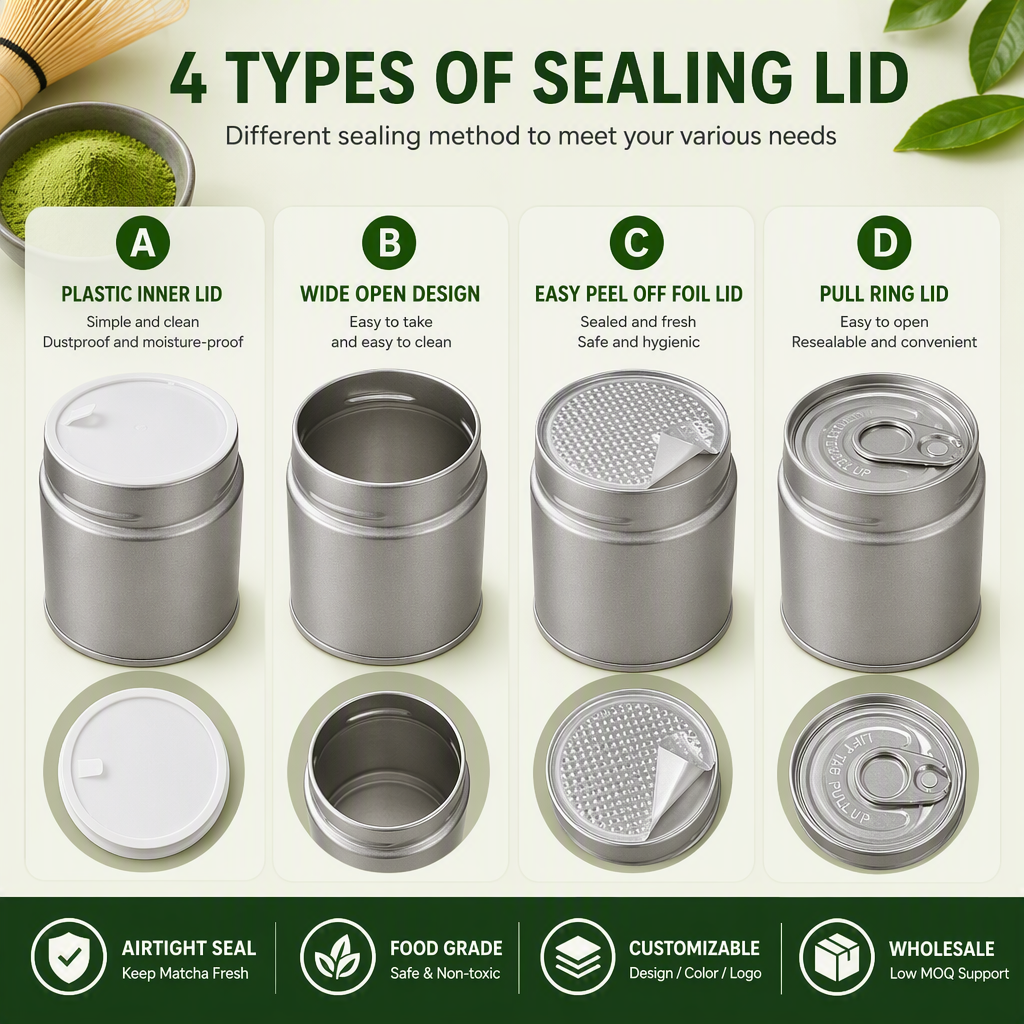
Both ring-pull ends and peel-off foil lids can protect matcha before first opening — if the complete pack is designed and validated as a system. The choice is not "which seal is better" but which seal your filling partner can run consistently, which opens cleanly with a full scoop of powder inside, and which pairs with an outer lid that genuinely reseals after the first use.
| Ring-pull end | Peel-off foil lid | |
|---|---|---|
| How it opens | Lift tab → tear scored metal panel | Grip tab → peel flexible membrane |
| Attachment | Double-seamed to the tin body | Heat-sealed to a matching rim, or pre-seamed on a ring |
| Tamper evidence | Metal panel is permanently removed | Membrane is permanently removed or torn |
| Reclosure | Separate outer lid (required) | Separate outer lid (required) |
| Critical controls | Score depth, tab attachment, seam spec | Membrane construction, bond consistency, peel force |
| Common failure modes | Tab bent in transit, panel distortion | Puncture, incomplete peel, powder on seal surface |
Neither seal reseals after opening. Neither determines shelf life on its own. Both need an outer lid and a storage system the customer will actually use.
Why matcha makes the seal decision harder than most powders
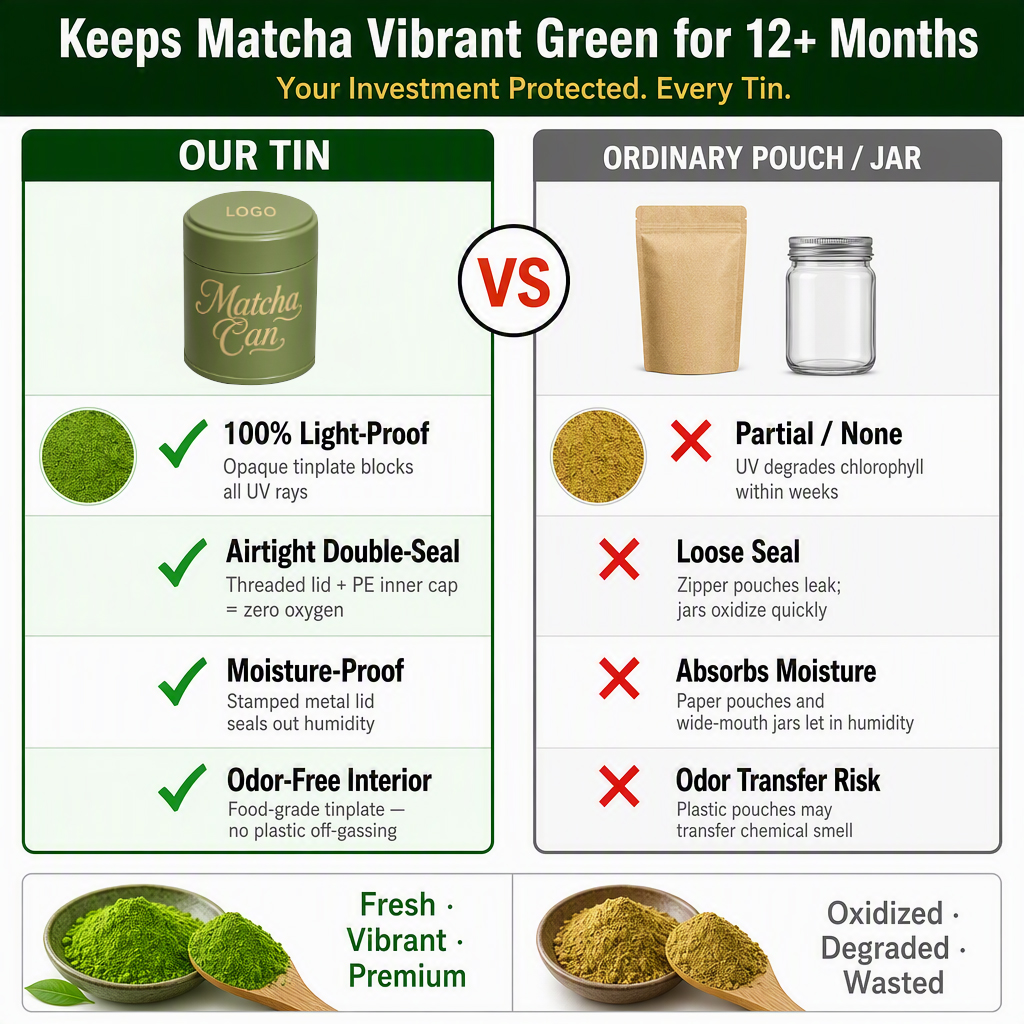
Matcha is stone-ground tea leaf — ultra-fine, hygroscopic and highly sensitive to oxygen, moisture, light and heat. Color degrades, aroma fades, flavor flattens. The packaging system exists to slow all of that.
What makes matcha different from coffee or cocoa:
- Particle size is extreme. Matcha is much finer than espresso grind. Fine powder migrates into seal surfaces during filling and can compromise heat-seal bonds.
- Fill weight is low relative to can diameter. A 30 g or 50 g fill in a standard-diameter can leaves a lot of headspace and a short column of powder — which means the opening diameter and spoon clearance need more attention.
- Customers open the can daily. Unlike a single-use pouch, the outer lid on a matcha tin gets opened and closed dozens of times. The reclosure system matters as much as the first seal.
One question changes the whole discussion: is the matcha loose inside the tin, or enclosed in a sealed inner pouch? If a pouch is the primary barrier, the inner tin seal is secondary protection. If matcha touches the tin directly, the seal and coating system carry the full barrier requirement. Settle that before comparing seal types.
What the two seal types actually are
Ring-pull end: a scored metal panel with a tab
A ring-pull end is a rigid metal disc with a controlled score line and a riveted pull tab. When the tab is lifted and pulled, it tears the panel along the score path. The panel is permanently removed — the original seal is gone.
The end must be specified and seamed to match the can body. What looks simple in a product photo involves: score geometry, tab attachment, end material and temper, double-seam dimensions and sealing compound. At Fancy Tin we supply the full end drawing and seam specification with every ring-pull tin project, because a mismatched end is one of the most common causes of problems in the filling trial.
Peel-off foil lid: a membrane, but the construction varies
"Peel-off foil" covers a range of constructions. The membrane may be:
- Heat-sealed directly to a prepared rim on the tin body — requires a heat-sealing station at the filler
- Pre-seamed on a steel ring — the assembled end is double-seamed conventionally, so no heat-sealing station is needed at filling
The second option is more filler-friendly and worth checking when your co-packer has a conventional seamer but no heat-sealer.
Also confirm what "foil" means in the quote. Aluminum foil laminates and metallized plastic films look similar but have different oxygen barrier properties, different recycling streams and different food-contact documentation requirements.
The filling conversation to have before you approve anything
The most expensive mistake in matcha tin development is approving artwork and tooling before confirming the filling route.
Send the proposed can body drawing and end specification to your co-packer and ask one direct question: "Through which opening will you fill, and what equipment do you have to close it?"
Two common routes:
- Bottom-fill: the tin is inverted, filled through the open bottom, and the bottom end is seamed on. The consumer-facing ring-pull or foil end is installed before filling and never touched by the filler. This is a clean route when the filling equipment supports it.
- Top-fill: product goes in through the top, and the filler then fits and seams or heat-seals the inner end. The equipment required depends entirely on the end construction selected.
One important detail specific to matcha: matcha dust on the sealing surface. An empty sample will look fine. A filled trial will show whether powder migrates to the rim during filling and whether the seal bond holds at production speed. This is why Fancy Tin recommends running a filled trial — not just a decoration sample — before production approval.
Barrier performance: what actually matters before first opening
It is tempting to compare the oxygen transmission rate (OTR) of a ring-pull panel versus a foil membrane and call it decided. That comparison is incomplete.
The full barrier of an assembled tin includes: body joints, double seams and their sealing compounds, the end material, and any membrane bond. A pinhole in the foil layer of a laminate behaves differently from a through-hole in the full laminate — barrier properties are determined by the complete assembly, not a single material test.
A meaningful comparison between the two formats means:
- Same matcha, same fill weight, same headspace, same filling process
- Defined residual oxygen target (especially if nitrogen-flushed)
- Package integrity testing on filled, sealed tins
- Monitoring color, aroma, moisture and flavor through the intended shelf life
If nitrogen flushing is part of the spec, agree a method for measuring residual oxygen immediately after sealing. Flushing reduces initial oxygen; the seal must then hold that atmosphere. A fast-reading headspace analyzer on filled samples is the check — not the flushing equipment spec alone.
The opening trial: test it as the customer will experience it
Samples can deceive. Someone at the factory lifts the tab for you, and the tin opens smoothly. The customer receives the closed pack, removes the outer lid, finds the tab themselves, and opens the seal while holding the tin over a kitchen counter.
Run the trial that way. With powder inside. With the outer lid on first.
Look for:
- Tab clearance — is there enough gap between the tab and the rim to get a finger in comfortably?
- Pull direction — is it obvious which way to pull without instructions?
- Release behavior — does the panel or membrane release cleanly, or does it snap and scatter powder?
- Residual obstruction — does anything left behind block spoon access or make it hard to reach the last gram?
- Outer lid fit after opening — does the outer lid seat properly on the now-opened tin?
ISO 17480 provides methodology for evaluating packaging ease of opening, including user testing with representative populations and grip strength considerations. For a premium matcha brand, this is not optional compliance paperwork — it is the difference between a positive first-use moment and a customer who switches supplier.
After opening, try scooping powder several times and reclosing. Powder build-up at the lid seat, uncertain closure feel, and dimensional fit changes with use are all failure modes of the outer lid — not the inner seal — but they affect the customer's daily experience more.
Reclosure deserves its own sample evaluation
Both formats require an outer lid once the inner seal is gone. Most matcha buyers use a screw lid or a tight-fit plug lid, but threads alone do not make a lid airtight. The sealing performance of an outer lid depends on the liner or gasket, the contact surface, dimensional tolerances and how the customer closes it.
Ippodo Tea — one of the most respected matcha houses — advises customers to keep matcha away from sunlight, heat, humidity and strong smells, and specifically discusses the difference between using matcha regularly from the tin versus keeping it in the inner pouch. This reinforces a practical reality: no outer lid replicates the original sealed environment. Storage instructions are part of the product, not an afterthought on the back of the label.
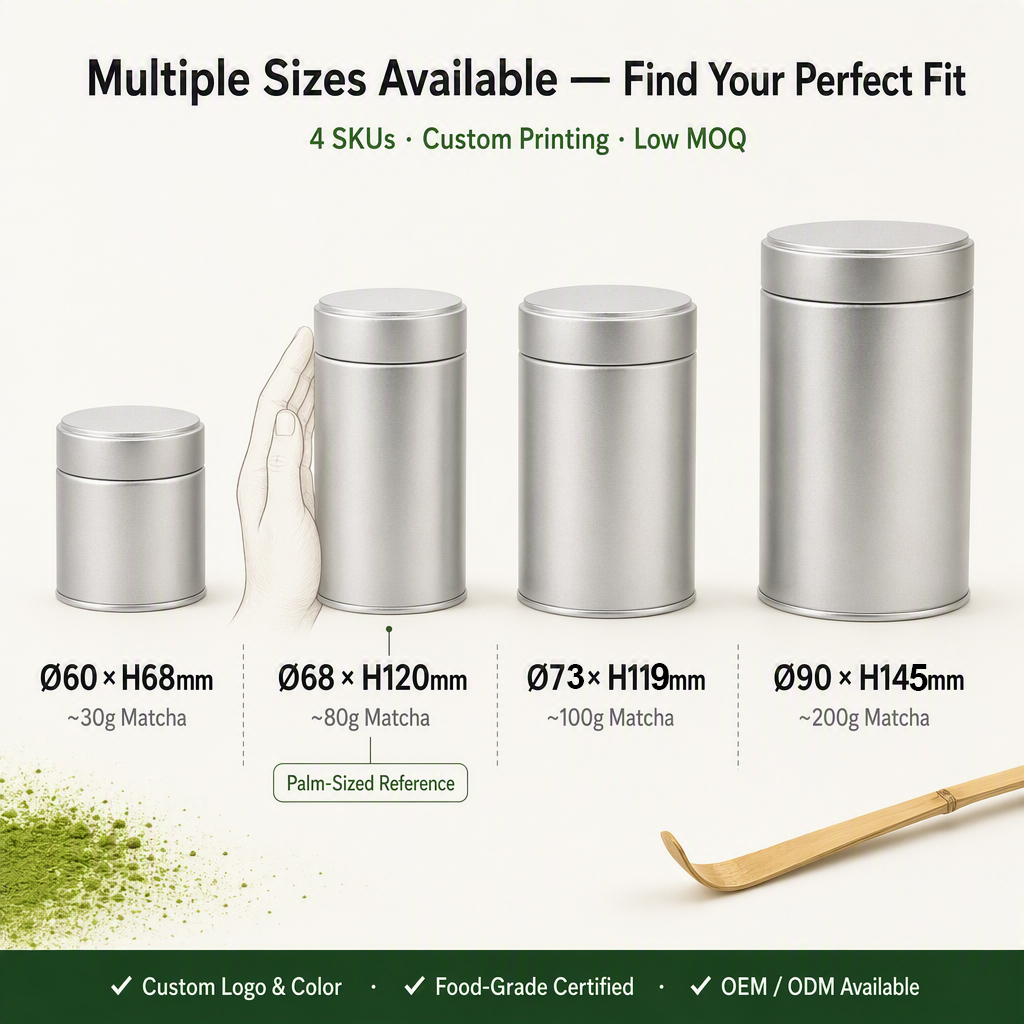
For larger pack formats (80 g and above), consider how long the tin will be open in normal use before it is finished. A smaller pack size paired with a simpler closure may serve the customer's freshness expectations better than a large tin with a technically superior original seal.
Total cost comparison: more than the component price
A foil membrane with a favorable unit price may require a heat-sealing station the co-packer does not own. A ring-pull end at a slightly higher piece cost may drop straight into an existing seamer. The total cost per packed, salable unit is what matters.
Build the comparison this way:
| Cost element | Include in the quote |
|---|---|
| Tin body | ✓ |
| Inner end (ring-pull or foil) | ✓ |
| Outer lid | ✓ |
| Printing and tooling | ✓ |
| Filling and seaming | ✓ |
| Gas flushing (if specified) | ✓ |
| Line trial and change parts | ✓ |
| Inspection and export packing | ✓ |
| Matcha loss in rejected runs | Estimate and include |
Ask for equivalent scope across all quotes before comparing numbers. A lower component price that arrives with undisclosed change-part costs or a filling trial fee is not a lower total cost.
Three sourcing scenarios with different right answers
An established co-packer already runs ring-pull cans
Start with their proven body–end combination. It gives you a validated baseline for seam quality and filling speed. Consider a foil format only when there is a specific, filler-confirmed advantage and the exact component has been validated — not just because the diameters match on paper.
A new brand wants a small 30 g or 50 g tin with a modern look
Check end availability for the target diameter first. Small-diameter openings require careful evaluation of tab clearance, usable opening area and spoon access. If compatible filling equipment is not available for a direct-seal foil, a sealed inner pouch inside a reusable decorative tin is a practical and increasingly popular alternative.
A café bulk-orders 250 g tins for daily service use
Daily scoop access and reliable reclosure matter most. The outer lid and seat cleanliness determine the experience after the first ten openings. Once those are validated, choose the inner seal based on the filling route and the unopened storage target — not on visual appearance alone.
What to check before production approval
Separate the appearance approval from the technical approval. A decorated sample confirms color, finish and branding. A filled trial confirms whether the proposed pack works with the actual product, equipment and shipping conditions.
Technical checks to complete:
- Seam specification — for seamed ends, get the seam drawing from the component supplier and agree inspection criteria with the filler. FDA guidance on double-seam evaluation provides useful engineering context on what a seam inspection should assess (though matcha is not a low-acid canned food, the measurement principles apply).
- Opening force — ring-pull initiation force and tear force are different from membrane peel force. ASTM F2824 defines test methods for continuous and maximum separation forces on flexible-lidded round containers. Agree the test method, pull angle, conditioning and acceptance range before the filled trial.
- Filled pack performance — use actual matcha, intended fill weight, outer lid and shipping carton. Run relevant drop and vibration tests and re-evaluate seal integrity and opening after.
- Written approval record — document body, end, membrane, coatings, outer lid and test results. Define what triggers a new trial if any component or process changes.
Food-contact documentation
Request food-contact documentation for every component that comes into contact with matcha: the inner coating of the tin body, the end material, membrane layers, heat-seal materials, sealing compounds and any gasket or liner in the outer lid.
The documentation should match the actual construction, the specific food (powder, high-surface-area, hygroscopic), the intended contact conditions and the destination market. For EU sales, the general food-contact framework — EU Regulation (EC) No 1935/2004 — applies alongside material-specific rules and national provisions. For the US, FDA's food-contact substances (FCS) framework governs clearance.
Also check recycling disposal guidance for each component in the target markets. A metallic-looking membrane may be aluminum, metallized plastic, or a laminate — three different recycling categories. The customer needs guidance.
Seven questions to answer before requesting a quote
- Is matcha filled loose into the tin, or packed in a sealed inner pouch?
- What is the fill weight, target dimensions and intended headspace?
- What shelf life and storage conditions need to be validated for the unopened pack?
- What filling, seaming or heat-sealing equipment does your co-packer operate?
- Is nitrogen flushing specified, and how will residual oxygen be measured after closure?
- What outer lid format and opening experience should the sample demonstrate?
- What is the order quantity, destination market and launch date?
Clear answers to these seven questions make quotes comparable and allow the supplier to flag an incompatible structure before tooling is ordered.
FAQ
Do ring-pull matcha tins seal airtight? A ring-pull end with a correctly specified double seam and sealing compound can provide a hermetic initial closure — but this must be validated in the complete filled pack, not assumed from the component spec. Once the panel is removed, the original seal is gone permanently.
Can peel-off foil lids be resealed after opening? No. All peel-off membranes discussed here are single-use. Once peeled, they cannot be reattached. The outer lid is the only reclosure available after first opening.
Which seal works better for a 30 g or 50 g matcha tin? Available end dimensions and filler compatibility determine the options. Then evaluate tab access, opening clearance and spoon reach on filled samples. Net weight alone cannot select the lid — volume, fill density and headspace all affect what works.
Can either format be nitrogen-flushed? Both can work with nitrogen flushing if the complete filling and sealing system is designed and validated for it. Confirm flushing sequence, time to closure, residual oxygen method and package integrity with your filler.
Can a foil membrane carry branding or opening instructions? Some membranes are printable. Confirm the print process is available and that artwork preserves tab visibility and pull direction. Verify ink and membrane construction compatibility for food contact before printing.
Which seal is safer for e-commerce shipping? Neither format makes a shipping decision on its own. Choose the pack that passes the relevant transit integrity tests, then protect it with an appropriate outer lid, cushioning and carton arrangement. A lid description alone cannot determine parcel performance.
What food-contact certificates should I request? Request documentation for each component that contacts food: tin body internal coating, end material and its coating, membrane layers and sealing materials, outer lid liner or gasket. Documentation must correspond to the actual construction, food type and destination market.
Start your matcha tin project with Fancy Tin
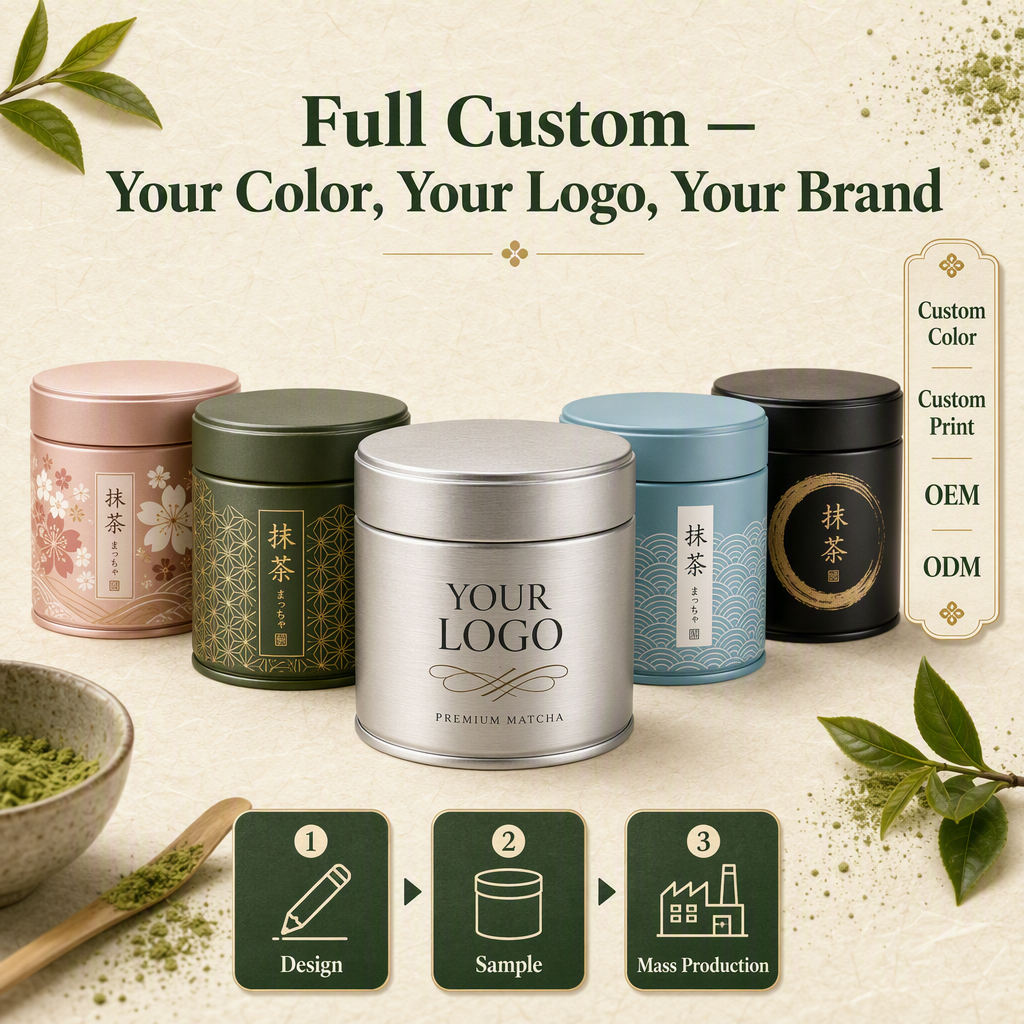
To get comparable quotes and avoid a costly revision after tooling, bring these details to the first conversation: target fill weight, tin dimensions, filling equipment, outer lid preference, brand direction and destination market. If you have a reference sample or drawing, include it — and ask us to confirm the proposed filling route and sample checks as part of the quotation.
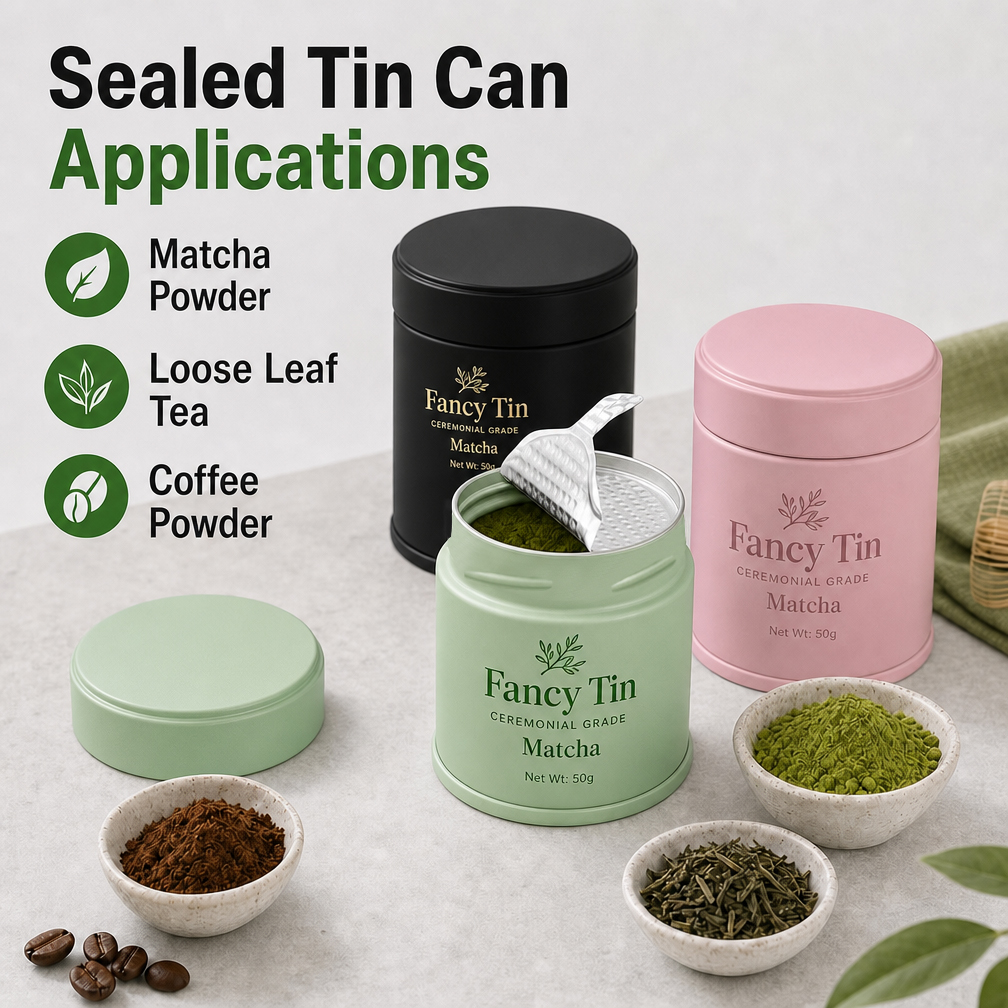
At Fancy Tin we supply matcha tins with ring-pull ends, peel-off foil lids and sealed-pouch-in-tin formats. We include the full component drawings, seam specifications and food-contact documentation that your co-packer and compliance team will need — before you commit to artwork or production.
Matcha Powder Tin Sizes: A Manufacturer’s Guide to Retail Packaging for Tea Brands