Matcha Storage : Is a Tin or a Bag Actually Better? (A Packaging Manufacturer's Technical Analysis)
Direct Answer: Is a Tin or a Bag Better for Matcha Storage?
Neither container is universally "better" on its own—they solve two completely different stages of matcha preservation.
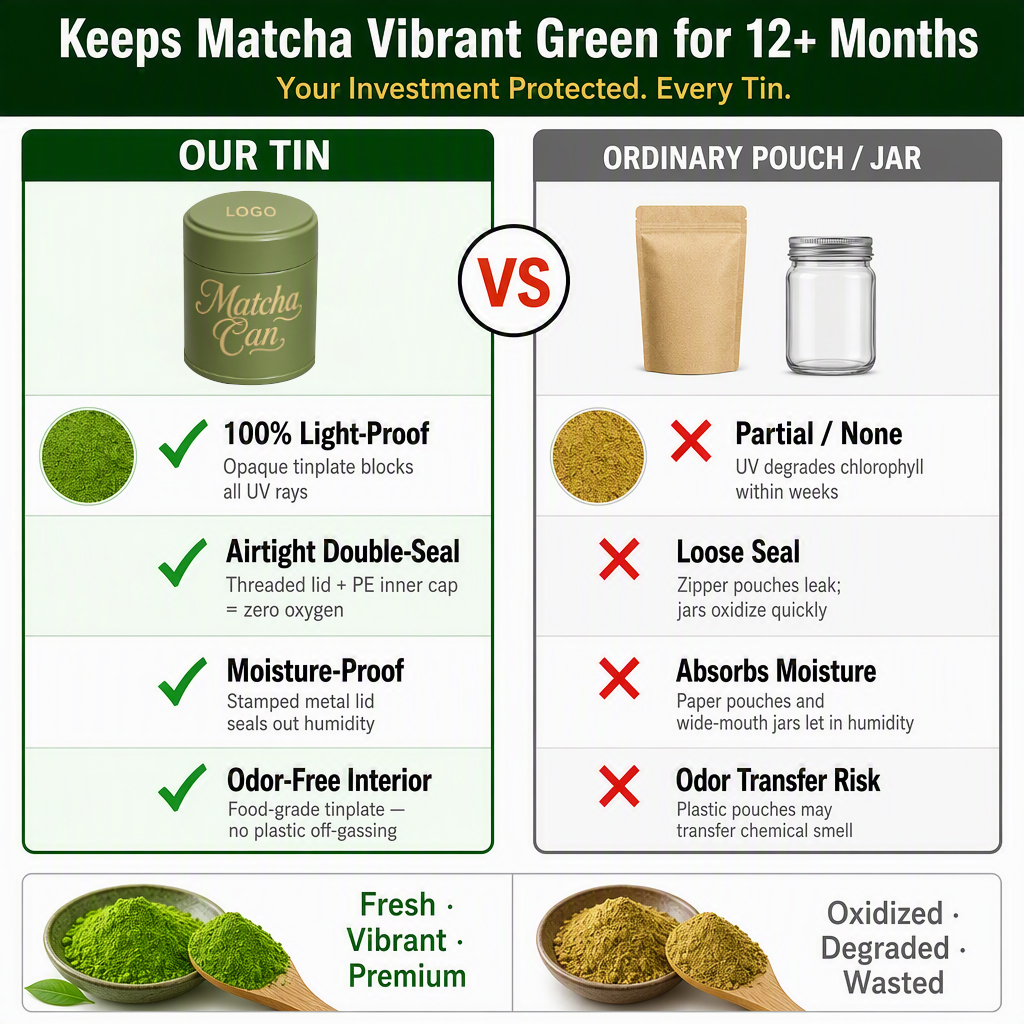
- For Unopened Shelf-Life (Commercial Distribution & Retail): Metal tins provide vastly superior barrier protection. Solid tinplate offers 100% complete opacity against ultraviolet and visible light, zero water vapor transmission (WVTR), structural crush-resistance in shipping, and the ability to hold high-vacuum nitrogen flushing (<1.0% residual O2<1.0% residual O2) over an 18-month retail shelf life. Flexible pouches risk pinhole micro-punctures, light transmission (unless thick foil laminates are used), and shipping deformation.
- For Opened, Daily Consumer Use: Flexible pouches have one physical advantage—collapsible volume. As matcha is consumed, air can be expelled from a flexible bag before resealing, minimizing the oxygen trapped inside. A rigid tin maintains a fixed volume; as powder is scooped out, ambient air fills the resulting headspace, accelerating post-opening oxidation if left in large canisters for months.
| Storage Factor | Standard Resealable Pouch | Basic Metal Canister | Premium Double-Lid / Foil-Sealed Tin | The Hybrid Solution: Nitrogen Pouch inside a Rigid Tin |
|---|---|---|---|---|
| Light Blocking (UV/Visible) | Moderate to Poor (risk if non-foil) | 100% Total Opacity | 100% Total Opacity | 100% Total Opacity |
| Pre-Opening Oxygen Barrier | Susceptible to zip-lock micro-leaks | High (depends on seal) | Hermetic (EOE / Peel-Off Foil) | Maximum (Double Barrier) |
| Crush / Puncture Resistance | Low (powder cake risk in mail) | High (rigid shell) | Very High (rigid tinplate) | Superior (armor + secondary barrier) |
| Post-Opening Headspace Air | Low (air can be pressed out) | High (fixed empty volume) | Moderate (inner plug reduces air exchange) | Low (bag folded inside rigid tin) |
| Gift & Brand Perceived Value | Low to Moderate (commodity feel) | High | Luxury / Ceremonial Standard | Highest (Japanese Tea Master Benchmark) |
At Fancy Tin, we frequently consult for tea brands who read amateur taste tests claiming "bags beat tins" and wonder if they should abandon metal canisters. That conclusion confuses consumer daily handling with commercial packaging engineering. The definitive solution adopted by top Kyoto tea houses (like Marukyu Koyamaen and Ippodo) is the Hybrid System: packing nitrogen-flushed, sealed foil sachets inside precision-fitted, double-lid metal tins. Below is the scientific breakdown.
1. The Physics of Matcha Degradation: The 4 Invisible Enemies
Matcha is not ordinary tea. Because it is stone-ground into micro-particles (5−10 μm5−10 μm), its specific surface area is exponentially larger than whole-leaf loose tea. When exposed to ambient air, four chemical degradation pathways trigger almost immediately:
[Stone-Ground Green Tea Powder]
             │
 ┌───────────┼───────────┬───────────┐
 ▼           ▼           ▼           ▼
[Oxygen]   [Light]     [Heat]    [Moisture]
   │           │           │          │
Oxidizes   Degrades    Accelerates Hydrolyzes
Catechins Chlorophyll Catechin   Aroma
   │           │       Epimerism  Volatiles
   ▼           ▼           ▼          ▼
[Bitter/   [Brown/     [Stale,   [Lumpy, Dull
 Flat]     Yellow]      Sour]      Flavor]
- Oxygen (O2O2): Oxidizes epigallocatechin gallate (EGCG) and polyphenols into brown-colored thearubigins, wiping out sweet umami and leaving flat, astringent bitterness.
- Light (Photodegradation): Chlorophyll is rapidly photobleached by both sunlight and fluorescent grocery shelf lighting. Clear bags or tins with plastic display windows can destroy a matcha's neon green hue in less than 72 hours.
- Moisture & Humidity: Hydrolyzes amino acids (L-theanine) and encourages clumping. High moisture transforms smooth electrostatic powder into stubborn granules that will not froth.
- Ambient Odor Transfer: The natural fats in tencha easily absorb volatile smells from kitchen cabinets, spices, and refrigerators.
2. Why Did the "Large Tin" Lose the Taste Test? Understanding Headspace Oxygen
The viral argument that "bags preserve matcha better than tins" stems from a very real phenomenon: the Headspace Oxygen Ratio.
In a rigid container, the internal volume (VtotalVtotal) remains constant. When you first open a 100g100g tin, powder fills 80%80% of the volume, leaving only 20%20% air. But as you scoop out matcha every morning, the ratio reverses:
Headspace Volume (Vheadspace)=Vtotal−Vpowder remainingHeadspace Volume (Vheadspace)=Vtotal−Vpowder remaining
When only 10g10g remains in a 100g100g rigid tin, nearly 90%90% of the canister is filled with trapped ambient room air (approx. 21% O221% O2). Every time the user opens the lid, scoops powder, and closes it, fresh oxygen is introduced and sealed inside. Over a 3-month period, that large volume of trapped air gradually oxidizes the remaining tea.
The Pouch Advantage (and its Fatal Flaws)
A flexible stand-up pouch (Doypack) allows the consumer to squeeze excess air out before pressing the zip-lock shut. This eliminates the growing air pocket.
However, pouches introduce severe commercial risks:
- Ziplock Matcha Clogging: Ultra-fine matcha powder invariably coats the zipper grooves. Once powder cakes inside the micro-tracks, the zipper can no longer achieve an airtight seal, resulting in invisible ambient air leakage.
- Pinholes & Crease Cracking: Aluminum-foil composite films are prone to microscopic foil fracturing when bent or creased repeatedly during daily opening and squeezing.
- Transit Crushing: In e-commerce mailers, pouches offer zero structural defense. A squashed pouch compacts fine matcha into dense cakes and ruptures side seams.
- Poor Retail Presence: On supermarket or boutique tea shelves, pouches slouch, crease, and convey a low-price bulk commodity aesthetic.
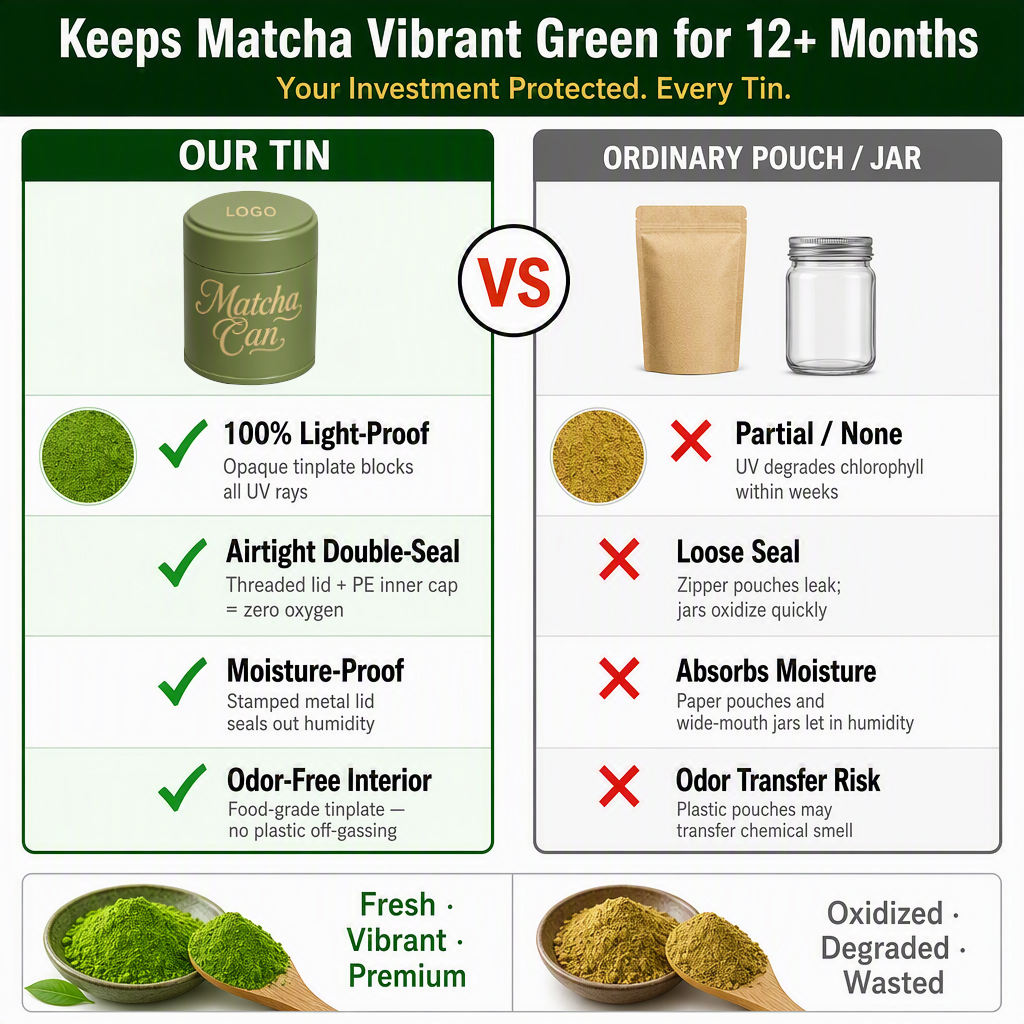
3. The Industrial Verdict: Why Metal Tins Remain the Commercial Gold Standard
If bags eliminate headspace air, why does almost every award-winning Japanese matcha house—from Uji to Shizuoka—package their highest competition grades in metal tins?
Because metal tins solve the entire commercial lifecycle, from factory nitrogen sealing through export transit to store shelves:
Advantage 1: Absolute Hermetic Sealing Prior to Opening
Using precision seamed ends—such as Easy-Open Pull Rings (EOE) or Peel-Off Aluminum Foil Membranes—a metal tin achieve a true gas-tight, zero-transmission seal. Flexible pouches sealed with heat bars frequently exhibit micro-channel leaks at corner junctions.
Advantage 2: Zero Light Transmission
Tinplate steel provides 100.0% barrier protection against light (0 Lux transmission). Even high-barrier plastic pouches with metalized coatings (VM-PET) can allow tiny percentages of UV penetration, degrading chlorophyll over a 12-month shelf life.
Advantage 3: Automated Vacuum & Nitrogen Flushing Compatibility
Industrial rotary can seamers can pull a vacuum and flush with high-purity nitrogen gas in fractions of a second, driving residual oxygen inside the tin down to below 0.5%. Pouches are notoriously difficult to nitrogen-purge at high speeds without blowing fine matcha powder into the heat-seal zone.
Advantage 4: Food-Grade Internal Lacquers
Modern tinplate canisters feature certified food-grade internal linings—such as BPA-NI (BPA Non-Intent) gold organosol or clear polyester lacquers compliant with U.S. FDA 21 CFR 175.300 and EU Regulation (EC) No 1935/2004. This completely prevents metal ion interaction with tea polyphenols.
4. The Solution: How Modern Tea Brands Engineer the Best of Both Worlds
You do not have to choose between the light-proof armor of a tin and the oxygen-evacuation advantage of a pouch. Leading global tea brands deploy three proven engineering strategies:
                      [Commercial Matcha Sizing & Architecture]
                                          │
         ┌────────────────────────────────┼────────────────────────────────┐
         ▼                                ▼                                ▼
  [Small Format Tins]           [The Hybrid System]             [Internal Plug Sealing]
   • 30g - 40g Net Weight        • Sealed Foil Pouch Inside      • Double Lid / Inner Cap
   • Consumed in 15-20 days      • Armor Outside / Squeeze Inside • Friction Fit Barrier
   • Zero Headspace Risk         • 100g+ Catering / Retail       • Traditional Ceremonial
Strategy A: Right-Sizing the Tin (The 30g Rule)
The simplest way to beat headspace oxidation is to size the tin to the consumer's consumption velocity:
- A single bowl of matcha uses 1.5g−2.0g1.5g−2.0g.
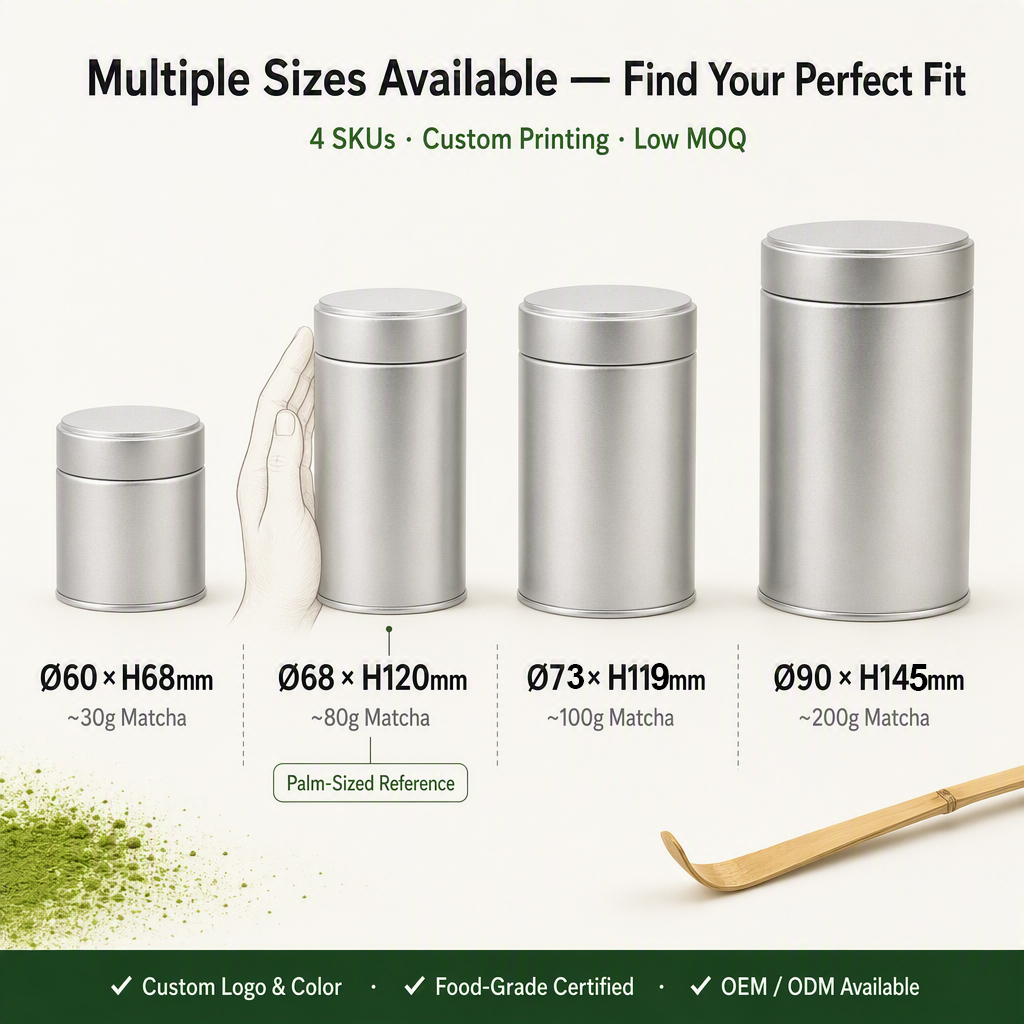
- A standard 30g tin (∅53×65 mm∅53×65 mm or ∅57×60 mm∅57×60 mm) provides only 15 to 20 servings.
- A regular drinker finishes the entire container in 2 to 3 weeks.
- Result: The tin is emptied before headspace oxygen can measurably degrade the powder. Never package un-bagged, single-origin ceremonial matcha in 100g+100g+ tins.
Strategy B: The Hybrid System (Pouch Inside a Tin)
For larger formats (50g50g, 80g80g, 100g100g, or 250g250g barista refill sizes):
- Package the matcha inside a sealed, nitrogen-flushed multi-layer foil pouch.
- Place the pouch inside a beautifully litho-printed Fancy Tin metal canister.
- How the Consumer Uses It: Upon opening, the customer snips the pouch corner, folds it down inside the tin to expel air, and pops the tin's secondary outer lid shut.
- The Result: The pouch protects against daily headspace air; the outer metal tin provides 100% light blockage, physical crush protection, and high-end brand presentation.
Strategy C: Precision Double-Lid Canisters (Inner Metal Plug)
Traditional Japanese tea canisters utilize an inner friction plug lid (Naka-buta) underneath the exterior slip lid.
- The inner lid slides snugly inside the tin body with tight dimensional tolerances (±0.15 mm±0.15 mm).
- As it slides down, it physically presses air out and sits just above the powder surface, dramatically restricting air interchange compared to loose screw-top caps.
5. Decision Matrix for Brand Owners & Packaging Buyers
When planning your packaging line, choose your format based on your retail distribution channel and price tier:
| Product Tier & Use Case | Recommended Packaging Architecture | Why This Wins |
|---|---|---|
| Ultra-Premium Ceremonial (Single Cultivar, Competition Grade) | 30 g Direct-Fill Tin with Ring-Pull / Peel-Off Foil Seal + Polypropylene Overcap | 100% hermetic factory seal; consumed within 14 days of opening; highest retail margin (30−30−55 MSRP). |
| Traditional Daily Matcha (Kyoto Heritage Style) | 40 g Tin with Double Lid (Inner Metal Plug + Outer Slip Lid) | Authentic tea-ceremony tactile ritual; inner plug restricts daily air ingress. |
| DTC Monthly Subscription Line | 50 g Hybrid Pack (Nitrogen Foil Pouch inside a Cylindrical Tinplate Canister) | Foil bag can be squeezed daily; outer tin arrives un-dented in the mail and sits proudly on kitchen counters. |
| Café Barista & Culinary Grade (Bulk / Refill) | 100 g – 250 g Hybrid Tin or Heavy-Duty Multi-Layer Resealable Gusset Bag | Value pricing; higher throughput; outer tin serves as permanent countertop dispenser. |
Frequently Asked Questions (FAQ)
Does storing matcha in the refrigerator stop oxidation?
Refrigeration slows down chemical oxidation and catechin epimerization, but it does not stop it if oxygen and moisture are present. Crucial rule: whenever taking matcha out of the fridge, let the container warm to room temperature for 15–30 minutes before opening. Opening cold matcha immediately draws warm ambient humidity onto the powder, causing condensation and instant clumping.
Why do some matcha tins have a pull-tab seal while others have a double lid?
A pull-tab seal (like an EOE ring-pull or peel-off foil membrane) provides a 100% hermetic, tamper-evident barrier for factory storage and export shipping. A double lid (with an inner metal or plastic plug) is designed for convenient daily opening and reclosing after that initial seal has been broken. The best modern tins combine both: a sealed peel-off foil top under a protective double-fit overcap.
Can I store matcha in a clear glass jar?
Never. Glass jars allow 100% light transmission. Light acts as a catalyst that rapidly bleaches bright green chlorophyll into pale brown, degrading flavor and vitamins in days. If glass is ever used, it must be heavy amber or violet Miron glass—though opaque metal tinplate remains far lighter, shatter-proof, and significantly cheaper to ship.
What is the typical shelf life of matcha in an unopened tin vs. a bag?
In a factory-sealed, nitrogen-flushed metal tin, ceremonial matcha can maintain peak quality for 12 to 18 months unopened at cool ambient temperatures (15∘C−20∘C15∘C−20∘C). In a standard heat-sealed foil pouch, unopened shelf life is typically 9 to 12 months due to potential micro-channel seal leakage and vulnerability to ambient handling. Once opened, both should ideally be consumed within 4 to 6 weeks.
How can a brand customize a matcha tin without paying high tooling costs?
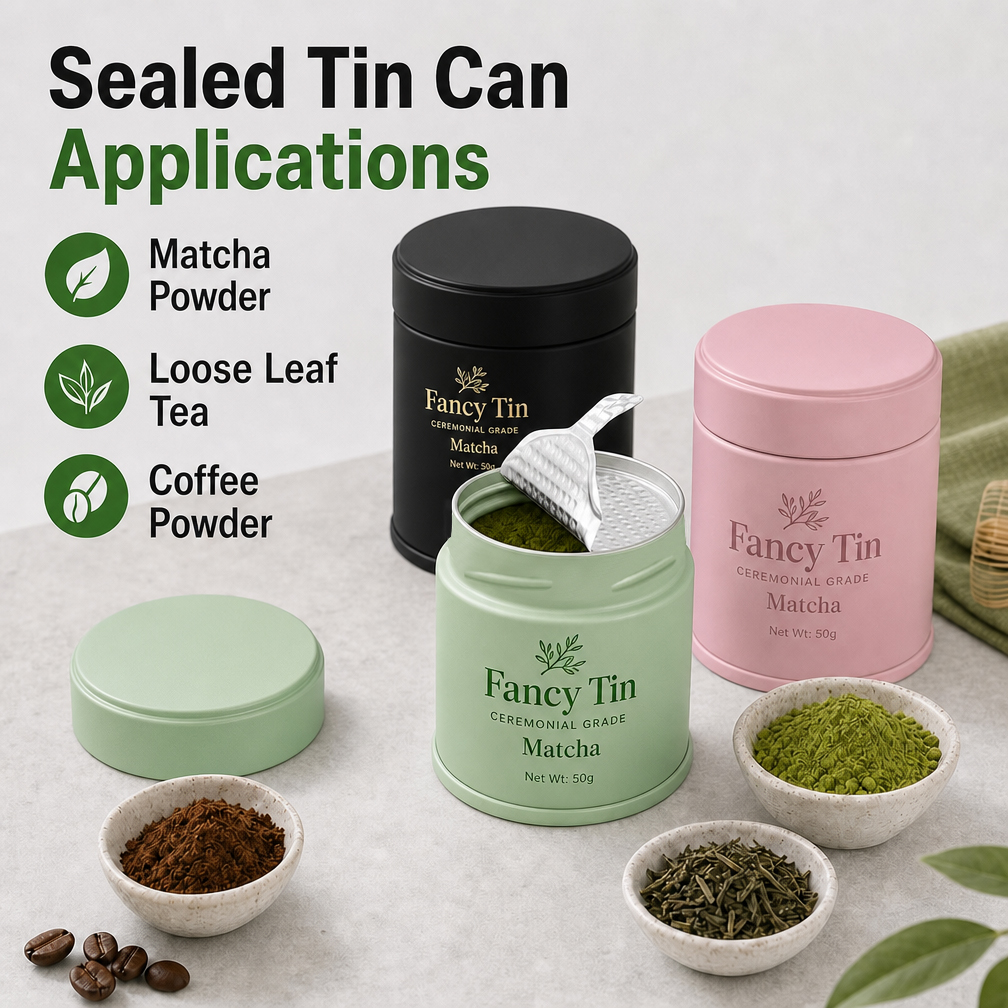
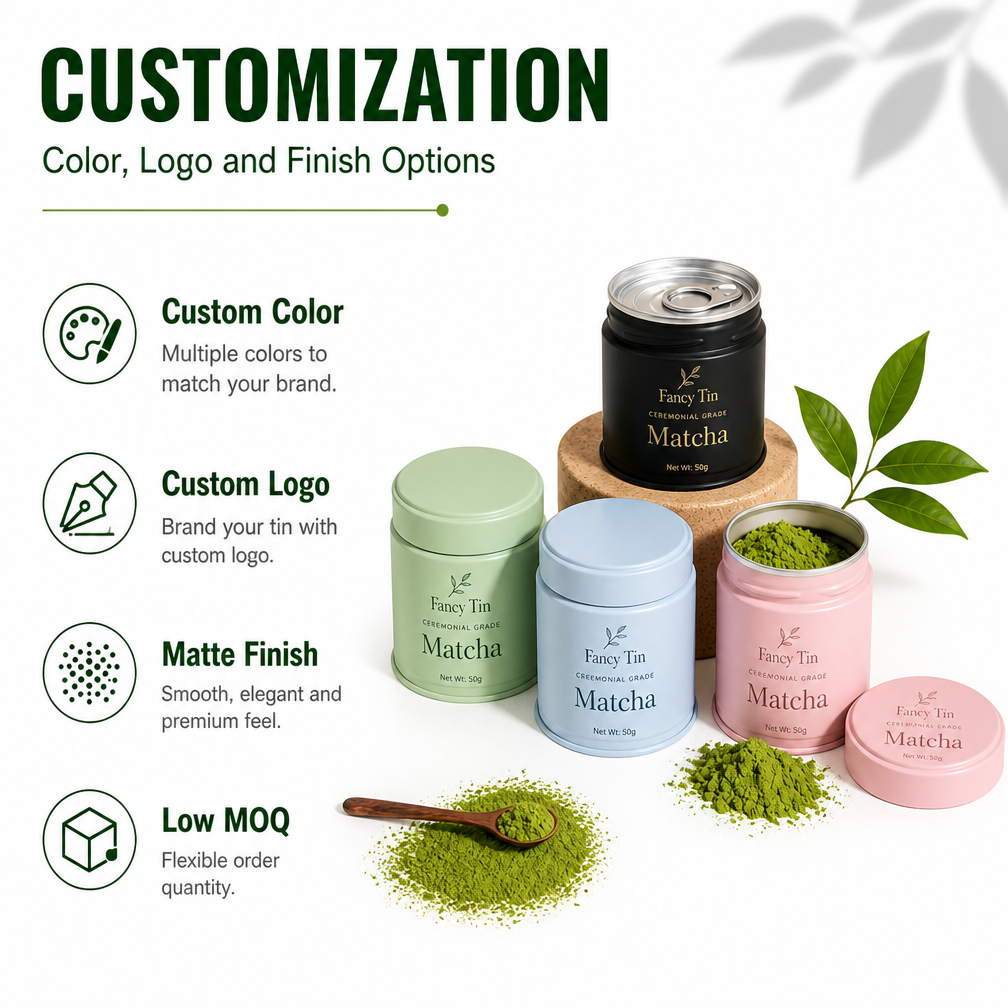
By leveraging an experienced packaging manufacturer's existing mold tooling. At Fancy Tin, we offer verified standard cylindrical matcha dies (∅53 mm∅53 mm, ∅57 mm∅57 mm, ∅65 mm∅65 mm, ∅75 mm∅75 mm) with zero mold fees. Brands can customize the exterior via 4-color process (CMYK) plus Pantone lithography, tactile matte varnishes, metallic ink underlays, and custom lid embossing starting at an MOQ of just 3,000–5,000 pieces.
Protect Your Matcha's Freshness with Fancy Tin
Don't let amateur storage advice compromise your tea's reputation. At Fancy Tin, we engineer metal packaging that balances laboratory-tested barrier performance with authentic Japanese tea ceremony aesthetics:
- 100% Light-Proof & Airtight Engineering: Precision double-lid friction plugs, hermetic peel-off foil membranes, and nitrogen-purge-compatible seamed ends.
- Certified Food-Grade Interiors: High-temperature cured BPA-NI gold organosol and clear polyester lacquers compliant with FDA 21 CFR and EU Regulation 1935/2004.
- Over 100+ Ready-To-Run Tea Molds: 30g30g, 40g40g, 50g50g, and 100g100g standard matcha footprints with zero tooling investment.
- Physical Sampling & Powder Fit Checks: We provide sample prototype cans to test with your co-packer's auger filling lines and foil pouches before mass production.
Contact Fancy Tin’s Tea Packaging Engineering Team for a Custom Quote & Sample Kit →
Matcha Powder Tin Sizes: A Manufacturer’s Guide to Retail Packaging for Tea Brands