Matcha Powder Tin Sizes: A Manufacturer’s Guide to Retail Packaging for Tea Brands
Direct Answer: How to Choose the Right Matcha Tin Size
Selecting retail packaging for matcha is not just a graphic design choice—it is a shelf-life preservation calculation. High-grade ceremonial matcha has a typical loose bulk density of 0.35 g/mL to 0.45 g/mL, meaning that 30 grams of stone-ground tencha powder occupies between 68 mL and 86 mL of physical volume prior to machine compaction or nitrogen flushing.
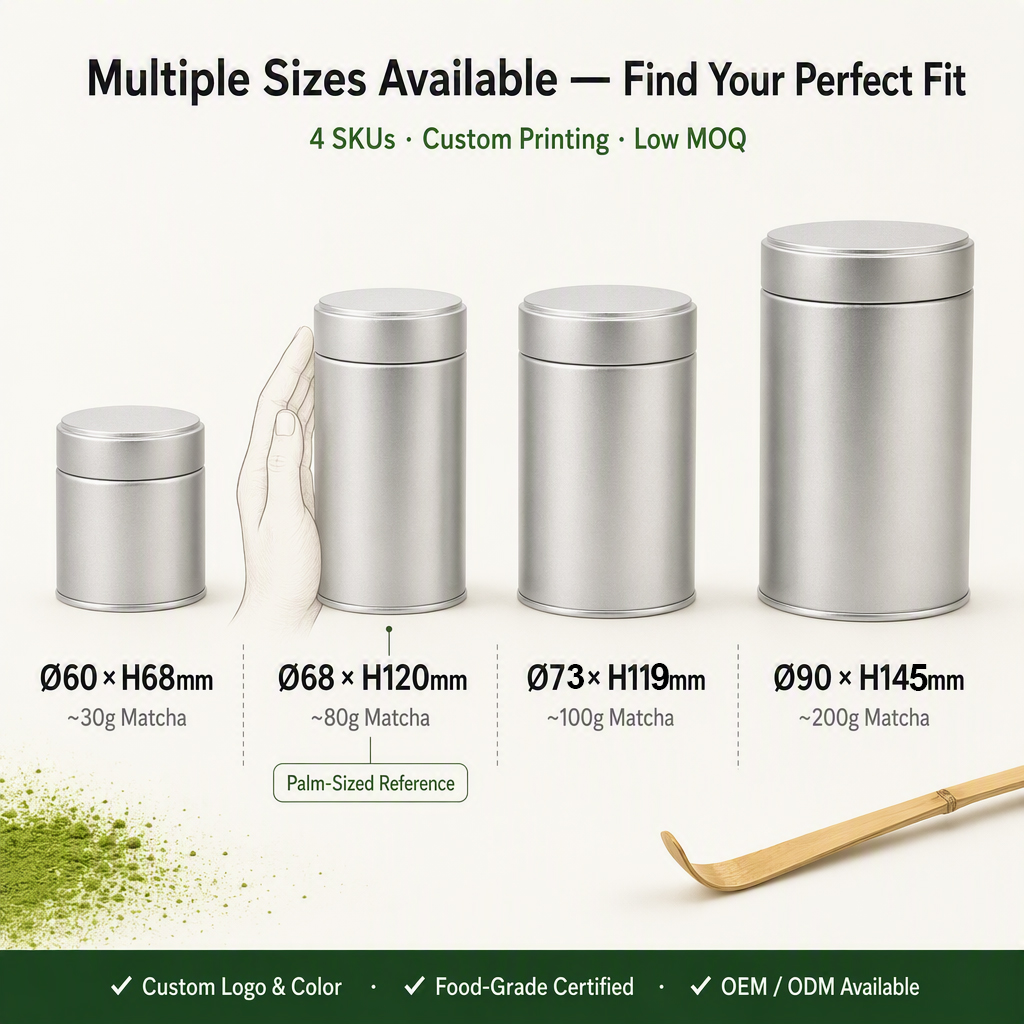
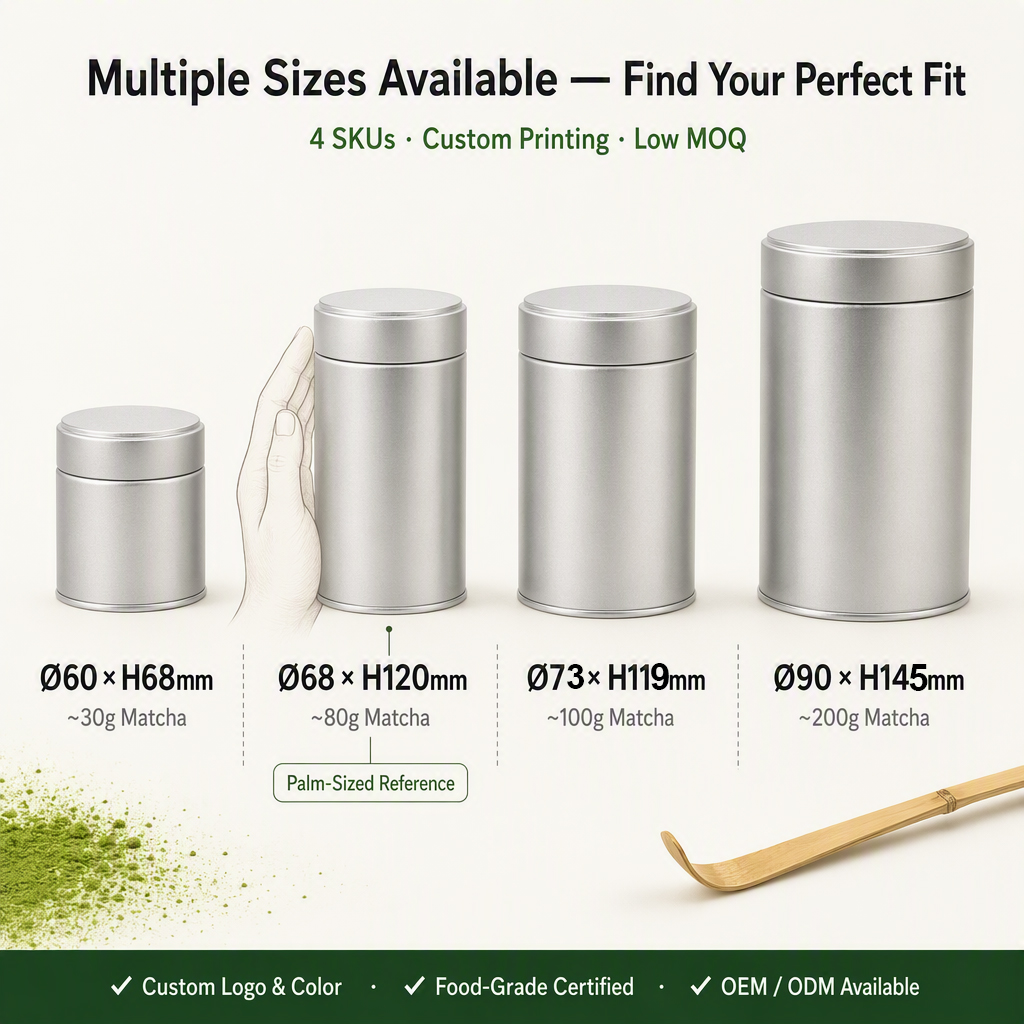
To protect flavor, volatile catechins, and chlorophyll from light, humidity, and oxygen, match your brand's retail format to one of these industry-standard dimensions:
| Retail Fill Weight | Standard Can Diameter ×× Height | Internal Usable Volume | Primary Packaging Barrier | Best Market Application |
|---|---|---|---|---|
| 30 g (Ceremonial Standard) | 53 mm×65 mm53 mm×65 mm or 57 mm×60 mm57 mm×60 mm | ≈100−115 mL≈100−115 mL | Double plug lid OR ring-pull + outer overcap | Single-cultivar ceremonial grades, gift tasting flights, entry-tier trial tins (15–20 bowls). |
| 40 g (Traditional Japanese) | 57 mm×70 mm57 mm×70 mm or 65 mm×55 mm65 mm×55 mm | ≈130−145 mL≈130−145 mL | Metal slip lid + inner airtight seal disc | Kyoto/Uji historical staple size; daily home whisking rituals (20–25 servings). |
| 50 g (Western Retail Favorite) | 65 mm×70 mm65 mm×70 mm | ≈175−190 mL≈175−190 mL | Peel-off foil membrane + polypropylene overcap | Premium supermarket & DTC subscription lines; monthly supply for active latte drinkers. |
| 100 g (Enthusiast / Value Pack) | 75 mm×85 mm75 mm×85 mm or 83 mm×80 mm83 mm×80 mm | ≈310−340 mL≈310−340 mL | Double-lid friction seal or pull-tab top | Daily matcha latte lovers, home culinary baristas, and small café display canisters. |
| 250 g – 500 g (Foodservice / Barista) | 83 mm×160 mm83 mm×160 mm or 99 mm×140 mm99 mm×140 mm | ≈700−950 mL≈700−950 mL | Industrial seamed ring-pull end + snap cap | Coffee shop espresso-bar stations, bakery commercial supply, and zero-waste refill tubs. |
At Fancy Tin, we manufacture millions of food-grade metal containers for global tea importers and private-label brands. The most critical lesson we share with clients is this: a premium matcha tin must be engineered from the inside out. Below is the complete factory guide to dimensions, sealing mechanics, food safety, and custom manufacturing.
1. Matcha Powder Physics: Why Volume Does Not Equal Weight
Matcha presents unique packaging challenges compared to loose-leaf black tea or whole coffee beans:
- Extreme Surface Area & Fine Particle Size: Stone-ground down to 5–10 microns, matcha particles behave almost like a fluid. They easily aerosolize during high-speed filling, settle over time into a compacted cake, and migrate into lid friction tracks if tolerances are loose.
- Bulk Density Variability: Depending on shading duration (Tana technique), grinding method (granite stone mill vs. modern jet mill), and moisture content (typically target 3%−5%3%−5%), the loose bulk density swings between 0.35 g/mL0.35 g/mL and 0.45 g/mL0.45 g/mL.
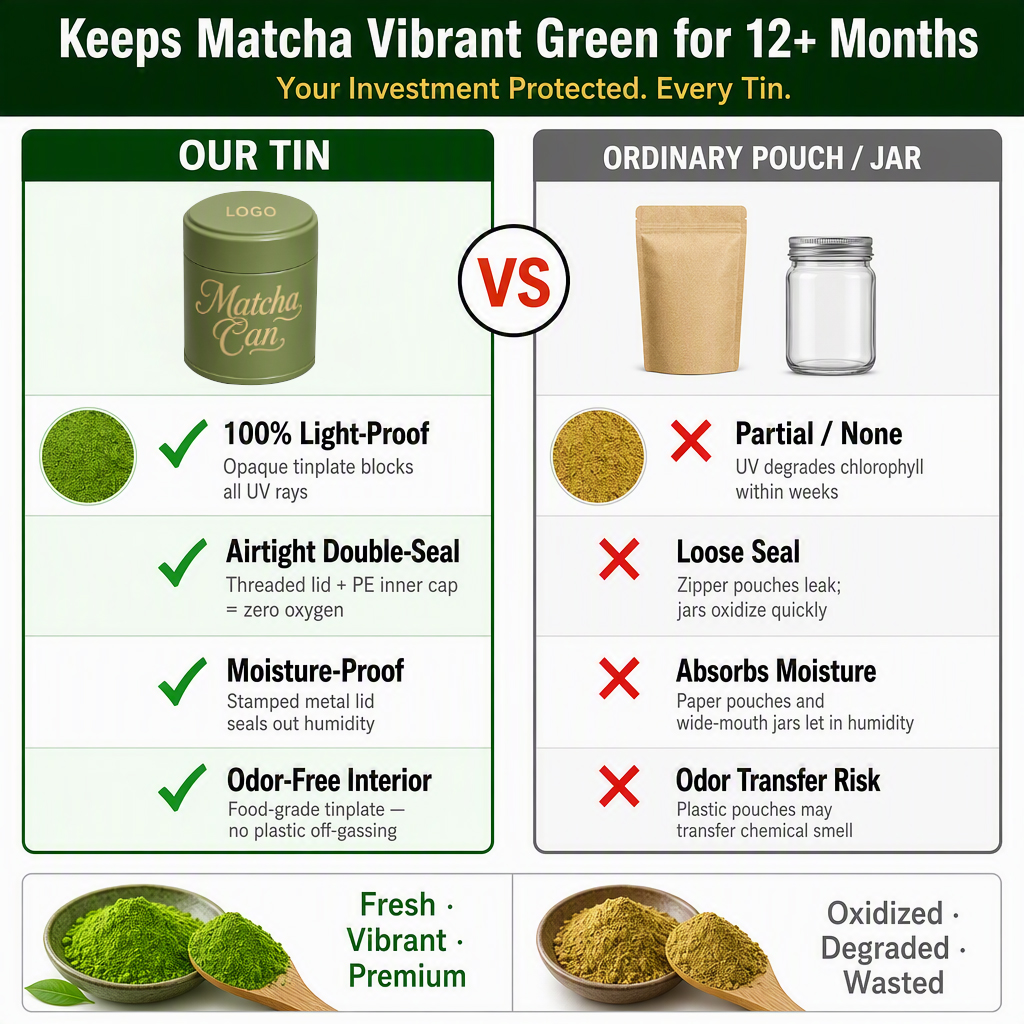
- The Degradation Triangle (Oxygen, Light, Heat): Exposure to ultraviolet or visible light bleaches vibrant green chlorophyll into an unappealing dull yellow-brown in days. Oxygen oxidizes delicate polyphenols, turning sweet umami into harsh astringency.
[Stone-Ground Tencha (3% Moisture)]
             │
             ▼
[Loose Bulk Density Measurement: 0.38 g/mL]
             │
             ├─► 30g Net Weight = 78.9 mL Powder Volume
             ├─► + 25% Headspace Margin (for Seaming Tooling & Gas Purge)
             └─► = 98.6 mL Minimum Required Canister Capacity
             │
             ▼
[Target Tin Dimension: Ø53 mm × 65 mm (110 mL Gross Volume)]
If you select a tin whose internal capacity exactly matches your powder's settled volume, you leave zero operational headspace. High-speed automated auger fillers will blow green dust across the rim, contaminating the sealing seam and ruining your closure's hermetic seal.
2. Retail Size Deep-Dive: 30g vs. 40g vs. 100g Formats
The 30g Tin: The Gold Standard for Premium Ceremonial Grade
- Why it dominates: At typical 1.5g−2g1.5g−2g preparations for Koicha (thick tea) or Usucha (thin tea), a 30g tin yields approximately 15–20 bowls. Once opened, matcha begins losing volatile aromatic notes within 3 to 4 weeks. A 30g container guarantees the customer finishes the tea while it remains emerald-green and fresh.
- Retail Pricing Dynamic: Enables high per-gram margins (28.00to28.00to45.00 retail MSRP), keeping the total ticket size accessible for new customers.
The 40g – 50g Tin: The Japanese Traditional & Subscription Favorite
- Why it works: In Kyoto (Uji, Wazuka), 40g is the historical benchmark size for household tins from iconic tea houses like Marukyu Koyamaen and Ippodo.
- For Modern DTC Brands: 40g or 50g fits a calendar month of daily drinking (1.5g/day1.5g/day for 30 days). This is the optimal size to power automated 30-day replenishment subscriptions.
The 100g Tin: The Value Anchor for Daily Latte Drinkers
- The Latte Formula: Customers making morning iced oat milk matcha lattes typically use heavier dosages (3g−4g3g−4g of powder to cut through plant milks). A 30g tin is exhausted in a single week.
- The Design Imperative: 100g containers must incorporate high-integrity reclosure mechanisms (such as double lids or interior plug seals). Because the tin will be opened 30+ times, secondary airtightness is mandatory to avoid oxidation before the last scoop.
3. Engineering the Closure: 4 Sealing Systems Compared
The outside of your tin establishes brand luxury on retail shelves; the inner closure determines your return rate and shelf life.
| Closure System | Initial Hermetic Barrier | Daily Reclosure Usability | Nitrogen Purge Feasibility | Production Line Requirement |
|---|---|---|---|---|
| Traditional Double-Lid (Outer Slip + Inner Metal Plug) | Moderate (metal-to-metal contact, non-hermetic without inner bag) | Superior. Inner plug seals out air smoothly every day. | Low unless pre-bagged in foil pouch. | Manual or simple automated capping. |
| Ring-Pull Easy-Open End (EOE) | Absolute 100% Hermetic. Vacuum / Nitrogen-tight. | Requires separate plastic or metal slip overcap for daily storage. | Excellent. Standard rotary seamer with gas flush tunnel. | Industrial can seaming machine required. |
| Peel-Off Aluminum Foil Membrane | 100% Hermetic. Zero sharp metal edges upon opening. | Requires secondary slip overcap after foil is peeled away. | Excellent. Compatible with Crown PeelSeam or direct heat-seal rings. | Heat-sealing station or standard double-seamer (if ring-mounted). |
| Threaded Screw-Top with EPE/Foam Liner | High (if liner compression torque is maintained). | Good, but fine matcha powder can clog threads over time. | Difficult to maintain vacuum without secondary membrane. | Rotary chuck capper. |
The Factory Recommendation: Direct Fill vs. Inner Foil Pouch
When setting up your product specifications, your co-packer will ask whether you are:
- Direct-Filling loose powder into the tin: You must use either an EOE / Peel-Off Foil seamed top or ensure the interior features a certified food-contact lacquer.
- Dropping a sealed multi-layer composite pouch into a decorative tin: In this scenario, the pouch serves as the primary oxygen barrier. The tin acts as an outer protective armor, preventing light damage, crushing in transit, and elevating gifting appeal.
4. Food Safety, Inner Lacquers & Regulatory Compliance
Never fill powdered tea into raw, unlacquered tinplate. Natural ambient humidity and microscopic condensation can cause oxidation on untreated steel over an 18-month shelf life.
When sourcing matcha tins, specify these manufacturing standards:
- Food Contact Material (FCM) Standards: Tins and inner coatings must fully comply with U.S. FDA 21 CFR 175.300 (Resinous and polymeric coatings) and European Framework Regulation (EC) No 1935/2004.
- BPA-NI (BPA Non-Intent) Lacquers: Global specialty retailers (Whole Foods, Erewhon, European organic markets) mandate BPA-NI interiors. At Fancy Tin, we apply food-grade clear polyester or gold organosol interior linings that pass stringent overall migration tests (OML) and specific migration tests (SML).
- Odorless Curing: Inks and varnishes must undergo high-temperature oven baking tunnels. If a supplier cuts curing time, volatile organic compounds (VOCs) can impart a chemical smell to the tin. Ground matcha absorbs surrounding odors immediately; high-temperature curing ensures zero odor migration into your tea.
5. Cost Breakdown & Sourcing Strategy: Stock Molds vs. Custom Tooling
Brand managers often assume that creating custom packaging requires tens of thousands of dollars in tooling. Here is the reality of tin manufacturing economics:
[Tooling & Production Cost Decision Tree]
                 │
  ┌──────────────┴──────────────┐
  ▼                             ▼
[Existing Mold Library]      [Bespoke Custom Tooling]
  • Tooling Cost: $0           • Tooling Cost: $2,500 - $5,000
  • Lead Time: 3 - 4 weeks     • Lead Time: 7 - 9 weeks (sampling + dies)
  • MOQ: 3,000 - 5,000 pcs     • MOQ: 10,000+ pcs
  • Customize via: Litho CMYK, • Customize via: Unique shape, custom
    Matte/Gloss, Embossing,      fluting, proprietary closure dimensions
    Inside-Lid Printing
How to Achieve Luxury Branding on Existing Tooling
You do not need an irregular custom die to build a high-end brand. Over 90% of leading Japanese and Western matcha houses use standard cylindrical footprints (∅53 mm∅53 mm, ∅57 mm∅57 mm, ∅75 mm∅75 mm) and differentiate through sophisticated surface treatments:
- Tactile Matte & Soft-Touch Coatings: Eliminates metallic glare, giving the canister a smooth, ceramic-like stoneware touch.
- Micro-Embossing / Multi-Level Debossing: Elevates Japanese kanji or minimalist logos into crisp physical relief on the lid.
- Pantone Metallic & Spot Gloss Varnish: Creates an understated luxury contrast against muted earth-tone backgrounds.
- Inside-Lid Print & QR Integration: Imprint preparation instructions, whisking water-temperature guides (70∘C−80∘C70∘C−80∘C), or origin traceability stories directly on the interior lid face.
Frequently Asked Questions (FAQ)
What is the exact millimeter size of a classic 30g matcha tin?
The most widely adopted retail size for a 30g loose-fill matcha canister is Diameter 53 mm ×× Height 65 mm (roughly 2.08" ×× 2.56") or Diameter 57 mm ×× Height 60 mm. Both yield approximately 110 mL to 125 mL of internal volume, providing the ideal ratio of powder space to nitrogen-flush headspace.
Why do Japanese matcha tins have an inner plastic or metal plug lid?
The inner friction plug (often made of tinplate or food-grade PE) serves as a secondary barrier for daily use. While the outer lid provides aesthetic branding and stackability, the tight-fitting inner lid prevents ambient air and kitchen humidity from entering each time the container is opened, extending freshness across 20+ daily servings.
Can matcha tins be recycled indefinitely?
Yes. Tinplate is made of steel coated with a microscopic layer of tin, making it one of the world's most recycled packaging materials. Metal tins have an established magnetic recovery stream across municipal recycling infrastructures globally, unlike multi-layer foil pouches which frequently end up in landfills.
How much headspace is required for automated matcha powder filling?
Confectionery and tea packaging engineers recommend reserving 15% to 25% free headspace between the powder level and the top rim of the can body. Insufficient headspace causes powder to blow back into the seaming chuck during vacuum/nitrogen flushing, creating weak double-seams and causing micro-leaks.
What is the standard production MOQ for custom printed matcha tins?
When utilizing existing cylindrical factory molds, Fancy Tin accommodates custom full-color lithographic printing starting at 3,000 to 5,000 pieces per design. For unprinted blank silver/gold tins intended for local labeling, minimum order quantities can start as low as 1,000 pieces.
Build Your Signature Matcha Packaging with Fancy Tin
Packaging is the silent ambassador of your tea's heritage. Whether you are launching a direct-from-farm single-origin ceremonial line or scaling wholesale barista blends across nationwide coffee chains, Fancy Tin delivers precision-engineered metal packaging:
- 100+ Ready-To-Run Tea Molds: Avoid upfront die fees with our verified inventory of 30g30g, 40g40g, 50g50g, 100g100g, and 250g250g airtight canisters.
- Airtight Engineering: Complete closure solutions including double friction lids, seamed EOE easy-open pull tabs, and peel-off foil membranes.
- Purity & Safety Assurance: 100% food-grade BPA-NI internal coatings with full FDA, LFGB, and EU 1935/2004 compliance test documentation.
- Physical Sampling: Request pre-production tin samples to validate filling line clearances, powder headspace, and unboxing tactile feel.
Contact Fancy Tin’s Packaging Engineering Team for a Custom Quote & Sample Kit →
Matcha Storage : Is a Tin or a Bag Actually Better? (A Packaging Manufacturer's Technical Analysis)
Ring-Pull vs Peel-Off Foil Lids for Matcha Tins | Fancy Tin