What Size Tin Do You Need for Mints? Sizing Guide | Fancy Tin
Direct Answer: How to Correctly Size a Mint Tin
You cannot choose a mint tin based on net weight alone. A 30g target fill of micro-mints occupies a completely different volume than 30g of chalky compressed lozenges or coated spheres. To correctly size a mint tin, use this three-step formula:
- Calculate Product Bulk Volume (VproductVproduct): Divide your target net weight (WW) by the measured loose bulk density (ρbulkρbulk) of your finished, coated confectionery.
- Account for Internal Packaging (VpouchVpouch): If using a sealed barrier pouch or glassine liner, add 20% to 35% extra volume for the fin-seals, corner folds, and pillow effect.
- Reserve Clearance for the Closure (HheadspaceHheadspace): Deduct the internal intrusion depth of hinged lips, curl edges, or sliding rails (typically 2.0 mm to 4.5 mm) from the tin's gross internal height.
| Packaging Format | Typical Net Weight | Common Tin Footprint (L×W×HL×W×H) | Usable Capacity (approx.) |
|---|---|---|---|
| Micro Hinged Pocket Tin | 10 g – 15 g | 60×48×15 mm60×48×15 mm | ~32 mL |
| Standard Classic Pocket Tin (Altoids style) | 30 g – 50 g | 95×60×21 mm95×60×21 mm | ~95 mL |
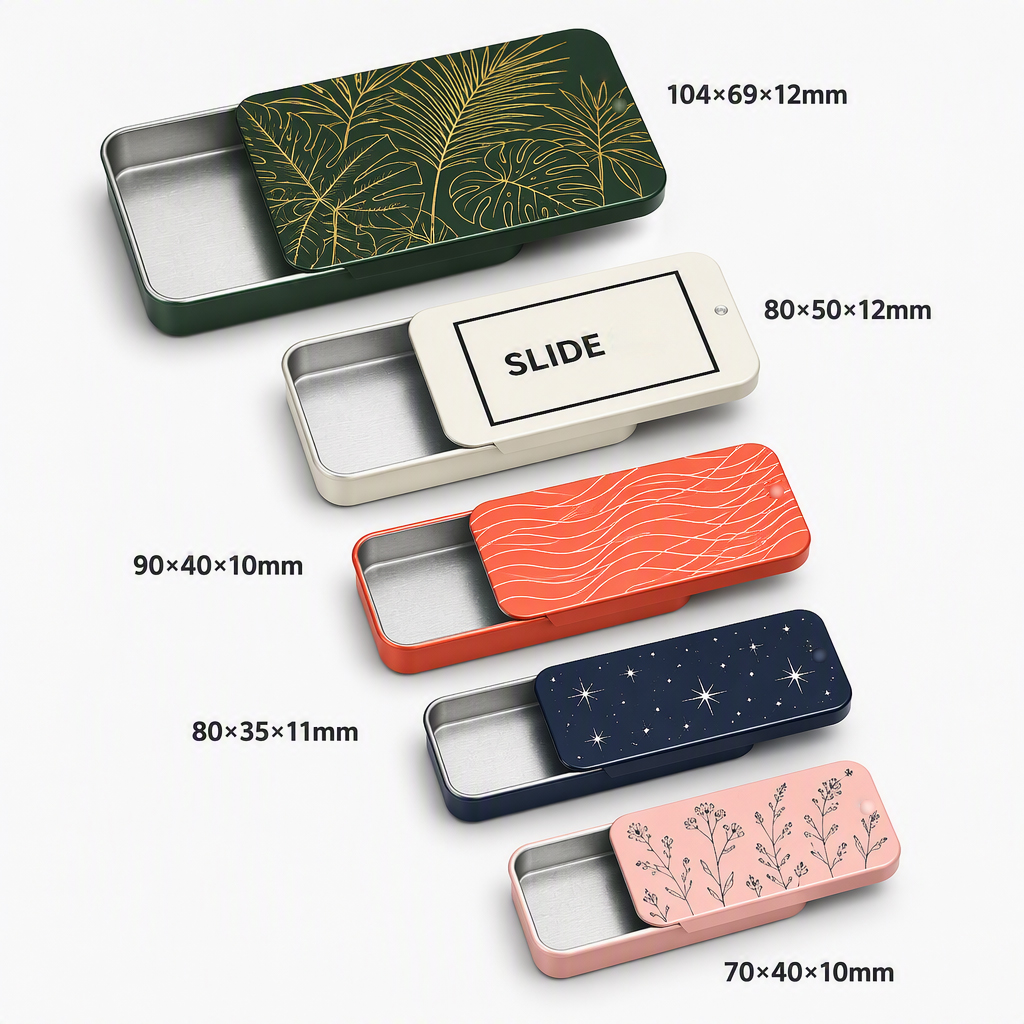
| Compact Slide-Top Tin | 12 g – 20 g | 70×40×13 mm70×40×13 mm | ~28 mL |
| Square Click-Clack / Hinged Tin | 20 g – 35 g | 60×60×18 mm60×60×18 mm | ~52 mL |
| Bulk / Hospitality Sharing Tin | 100 g – 150 g | 110×80×28 mm110×80×28 mm | ~210 mL |
At Fancy Tin, we see brands lose weeks of development time by ordering pre-production artwork for a "standard 30g tin" that physically cannot close once a food-grade foil pouch is dropped inside. Below is the exact engineering methodology we use to calculate usable space and ensure smooth high-speed filling.
1. Why Net Weight Deceives: Understanding Confectionery Bulk Density
In metal packaging procurement, the most common inquiry is: "Do you have a stock mold for a 25g mint?"
However, tinplate containers are volumetric vessels (measured in milliliters or cubic centimeters), whereas confections are sold by commercial weight (grams or ounces). The link between the two is bulk density (g/cm3g/cm3 or g/mLg/mL).
Bulk density is not the intrinsic density of the sugar or xylitol crystal itself; it accounts for the void spaces, air gaps, surface texture, and geometric packing behavior between individual pieces. Standardized testing methods, such as ASTM D7481 (Standard Test Methods for Determining Loose and Tapped Bulk Densities), demonstrate how loose-pour settlement differs significantly from mechanically tapped settlement.
Bulk Density Variations Across Common Mint Types
| Confectionery Type | Physical Shape & Surface | Packing Efficiency | Typical Loose Bulk Density (g/mLg/mL) | Volume Needed for 30 g Fill |
|---|---|---|---|---|
| Pressed Micro-Mints | Tiny flat bi-convex discs (5 mm∅5 mm∅) | Very high (tight nesting) | 0.80−0.900.80−0.90 | ≈33−37 mL≈33−37 mL |
| Standard Chalky Lozenges | Thick tablets (10−12 mm∅10−12 mm∅) | Moderate (edge-to-edge gaps) | 0.62−0.720.62−0.72 | ≈42−48 mL≈42−48 mL |
| Coated Chewy Pellets | Rounded pillow / dragee | Medium-low (slippery random pack) | 0.58−0.680.58−0.68 | ≈44−52 mL≈44−52 mL |
| Aerated / Extruded Mints | Irregular, rough crystallised shapes | Low (large void channels) | 0.45−0.550.45−0.55 | ≈55−67 mL≈55−67 mL |
| Individually Twist-Wrapped | Hard candy mints with film tails | Extremely low (fluffy air pockets) | 0.28−0.380.28−0.38 | ≈80−107 mL≈80−107 mL |
The Engineering Takeaway: Switching from a compressed tablet to an individually flow-wrapped piece of the same 30 g net weight requires up to three times the internal can volume.
2. Gross Internal Volume vs. Usable Space: The 3 Phantom Thieves
When inspecting an engineering drawing from a tin manufacturer, the published measurements (L×W×HL×W×H) represent exterior envelope dimensions unless explicitly designated as internal dimensions (IDID).
Even when internal dimensions are specified, Gross Internal Volume ≠= Usable Fill Volume. Three structural features steal usable packaging space:
Thief #1: The Inner Curl and Lid Inset
To eliminate sharp metal edges and comply with consumer safety standards, tinplate bodies have hemmed or curled edges.
- On a hinged tin, the bottom body curl rolls outward or inward, and the lid has an inward flange that slips inside or over the rim.
- When the hinged lid shuts, the structural stepped profile often drops 1.5 mm to 3.5 mm into the can cavity.
- If your loose mints or sealed pouch sit flush with the top body edge, closing the lid will crush the product or rupture the film.
Thief #2: Corner Radii (RR)
Pocket tins are rarely sharp rectangles; they feature rounded corners (R=5 mmR=5 mm to R=15 mmR=15 mm) for pocket comfort and deep-draw stamping integrity.
- Sharp rectangular math (L×W×HL×W×H) artificially inflates calculated volume by 6% to 12%.
- A 95×60×21 mm95×60×21 mm tin does not provide 119.7 mL119.7 mL. Once corner radii and metal thickness (0.21 mm−0.23 mm0.21 mm−0.23 mm tinplate) are factored in, true internal volume drops to roughly 104 mL104 mL.
Thief #3: Slide-Top Rails & Stop Dimples
On two-piece sliding tins (slider tins):
- The lid slides along rolled hem tracks on the body.
- Embossed "stop dimples" prevent the lid from falling off.
- The entry clearance under the slide rail restricts vertical filling height by at least 2.0 mm across the entire length of the slide stroke.
3. The Inner Packaging Factor: Pouches, Glassine, and Tamper Seals
Direct food contact in decorative tins is subject to stringent global regulations, including U.S. FDA 21 CFR Food Contact Substances and Regulation (EC) No 1935/2004.
While Fancy Tin manufactures tins with certified food-grade internal gold lacquers or clear organosol coatings, many brands enclose their mints in an inner primary barrier for moisture resistance and tamper evidence.
The Pouch "Pillow Effect"
An empty foil pouch laid flat looks negligible in thickness (<0.1 mm<0.1 mm). However, once filled with 30 g of mints and heat-sealed:
- The pouch forms a natural three-dimensional "pillow" with rounded bellies and stiff, flat heat-seal fins at both ends.
- The folded fin seals require clearance along the container's side walls.
- Attempting to force the sealed tail under a hinged cover risks catching the barrier film in the hinge pinch-point, puncturing the bag, or preventing the lid clasp from snapping shut.
Factory Benchmark: If your specification calls for a sealed multi-layer barrier bag inside the tin, specify a tin with at least 25% greater interior volume and 3 mm more depth than would be required for loose-filled tablets of the same weight.
4. Bench Testing Protocol: How to Validate Fit Before Cutting Tooling
Never sign off on mass production tooling or print runs based solely on a PDF layout or 3D render. Before committing capital, conduct this physical bench validation:
[Target Net Weight / Piece Count]
            │
            ▼
[Loose Bulk Density Calculation] ──► (ASTM D7481 Standard)
            │
            ▼
[Sample Sizing Match] ────────────► (Shortlist 2-3 Existing Molds)
            │
            ▼
[Physical Fill & Shake Trial] ────► (Real Mints + Actual Pouch)
            │
            ├─► 1. Check Lid Free-Close (Zero Resistance)
            ├─► 2. Check Dispensing Ergonomics (Finger / Pour Clearance)
            └─► 3. Measure Transit Rattling / Breakage Margin
            │
            ▼
[Production Line Clearance] ──────► (Automated Feeder Compatibility)
Step-by-Step Verification Checklist
- Tare and Measure Production Mints: Measure 10 individual pieces with a digital caliper (thickness and diameter). Record any batch-to-batch variation.
- Weigh Target Net Quantity: Do not approximate. If target pack weight is 35 g35 g, weigh exact portions across 5 test sets.
- Bagged Trial Simulation: If using an inner wrapper, fill, heat-seal, and fold the bag using the exact film substrate intended for the commercial line.
- The "Free-Drop" Closure Test: Place the filled confections/bag into the prototype tin. Lower the lid gently without applying downward thumb pressure.
- Pass: The lid closes and snaps into the bead detents under its own weight.
- Fail: You feel sponge-like resistance from the pouch, or hear a tablet grind against the lid's inner profile.
- The Pocket Rattle & Abrasion Test: Seal the tin and shake it vigorously for 30 seconds. Open and inspect for tablet dust, broken corners, or chalky transfer onto the tin's interior walls. Excessive free space causes product degradation during shipping; insufficient space causes closure failure.
5. Standard Mint Tin Formats Compared
Choosing an existing tooling mold from our library saves between $1,500 and $4,500 in new tooling costs while shortening lead times by 3 to 4 weeks. Here is how the primary tin styles compare for mint packaging:
| Tin Architecture | Structural Characteristics | Filling Line Compatibility | Consumer Experience | Best Suited For |
|---|---|---|---|---|
| Hinged Lid Tin | Integrated wire hinge; snap clasp detents; curled edges. | Excellent for multi-head weighers and pick-and-place lines. | One-handed opening; satisfying snap sound; permanent lid. | Premium breath mints, organic lozenges, artisan candies. |
| Two-Piece Slide Tin | Sleeve and friction tray; rolled rail guide; stop dimple. | Best for automated indexing lines or pre-formed pouches. | Tactile slide action; controlled single-piece dispensing. | Pocket micro-mints, functional CBD/energy mints. |
| Seamless Deep-Drawn Tin | Stamped from single sheet; no side seams; slip lid. | High-speed rotary closing machines. | Smooth contours; leak-resistant base; classic aesthetic. | Hard-boiled mint drops, pastilles with wax paper liners. |
| Click-Clack / Press-To-Open | Circular tin; convex lid flexes open on center press; squeeze rim to close. | Specialized top-load capping equipment. | Novelty sensory interaction; highly collectible. | Sugar-free mini-spheres, novelty breath mints. |
6. Sourcing & Cost Efficiency: Ordering Strategy
To minimize cost per unit and streamline supply chain execution, consider these commercial rules of thumb:
- Leverage Existing Mold Heights: In metal stamping, changing the length and width of a tin requires completely new punching dies and curling tools ($2,500+). However, for many drawn or 3-piece tins, adjusting the body height by 2 mm to 5 mm can often be accomplished with simple spacer adjustments or lower-cost trimming modifications. Always ask Fancy Tin if an existing diameter or footprint can be trimmed to your required height.
- Factor in Master Carton Stacking: Compact tins pack tightly into secondary cartons. Ensure your outer dimensions align with standard export pallet dimensions (1200×1000 mm1200×1000 mm or 1200×800 mm1200×800 mm) to avoid paying for shipping air.
- Surface Finishes and Food Coatings: Matte coatings, spot gloss, metallic inks, and 3D embossing add tangible value to retail gift tins. Ensure that any external varnish does not migrate into the food-contact zone during stamping and stacking.
Frequently Asked Questions (FAQ)
What size tin do I need for a standard 30g mint pack?
For 30 grams of standard pressed mints (10 mm10 mm diameter, bulk density ≈0.68 g/mL≈0.68 g/mL), you need roughly 45 mL45 mL of loose volume. If packaged loose, a classic 60×50×15 mm60×50×15 mm hinged tin fits this comfortably. If you place those same 30 grams inside a sealed barrier foil pouch with folded fin seals, you will need a tin with at least 75 mL75 mL to 95 mL95 mL of internal volume, such as a 95×60×21 mm95×60×21 mm pocket tin.
Can I pack mints directly into a metal tin without a bag?
Yes, provided the tinplate is certified food-grade and coated with an approved internal lining (such as a food-contact epoxy-phenolic, BPA-NI polyester, or organosol lacquer) compliant with FDA 21 CFR and EU 1935/2004 standards. The container must also feature an exterior shrink band, tamper-evident adhesive label, or tear-tape outer wrap to guarantee shelf integrity at retail.
What is the difference between exterior and usable interior dimensions?
Exterior dimensions include the outer lid curls, hinge knuckles, and overall profile limits, which are used for shelf and carton layout. Usable interior dimensions account for metal thickness, corner radii, and especially lid closure intrusion (the distance the lid drops below the body rim when shut). Always calculate capacity using minimum internal clearances.
How do I stop mints from rattling and breaking inside the tin?
Rattling and transit chipping happen when headspace exceeds 15%15% of total interior volume. You can eliminate this by: (1) trimming the tin height to match settled fill height, (2) inserting an embossed food-grade parchment paper or food-safe corrugated glassine cushion pad on top, or (3) using a sealed inner pillow pouch that acts as a natural air buffer.
What is the minimum order quantity (MOQ) for custom-printed mint tins?
At Fancy Tin, custom offset-printed tin packaging typically starts at an MOQ of 5,000 pieces per design when utilizing our existing mold library. Bespoke newly-tooled sizes generally require an MOQ of 10,000 pieces to amortize machine calibration and lithographic printing runs.
Engineer Your Custom Mint Tin with Fancy Tin
Avoid costly packaging redesigns and production delays. Whether you need an iconic pocket hinged tin, a modern slide-top container, or a custom-contoured novelty package, Fancy Tin provides end-to-end technical support:
- Free Mold Matching: Instant access to over 1,200+ existing confectionery tooling dies.
- Physical Sampling & Volumetric Validation: Send us your raw mints, and our packaging engineers will conduct density and closure trials to determine the exact optimal dimension.
- Full Compliance Documentation: Certified food-grade lacquers, BPA-NI options, FDA/EU migration test reports, and export-ready packaging.
Contact Fancy Tin’s Engineering Team for a Custom Sizing Review →
The Ultimate Cookie Tin Box Sourcing & Engineering Playbook: Specifications, Tooling, Food Safety, and Unit Economics
Custom Chocolate Tin Packaging: A Factory Guide to Protection, Food Safety and Gift Appeal
Related Article