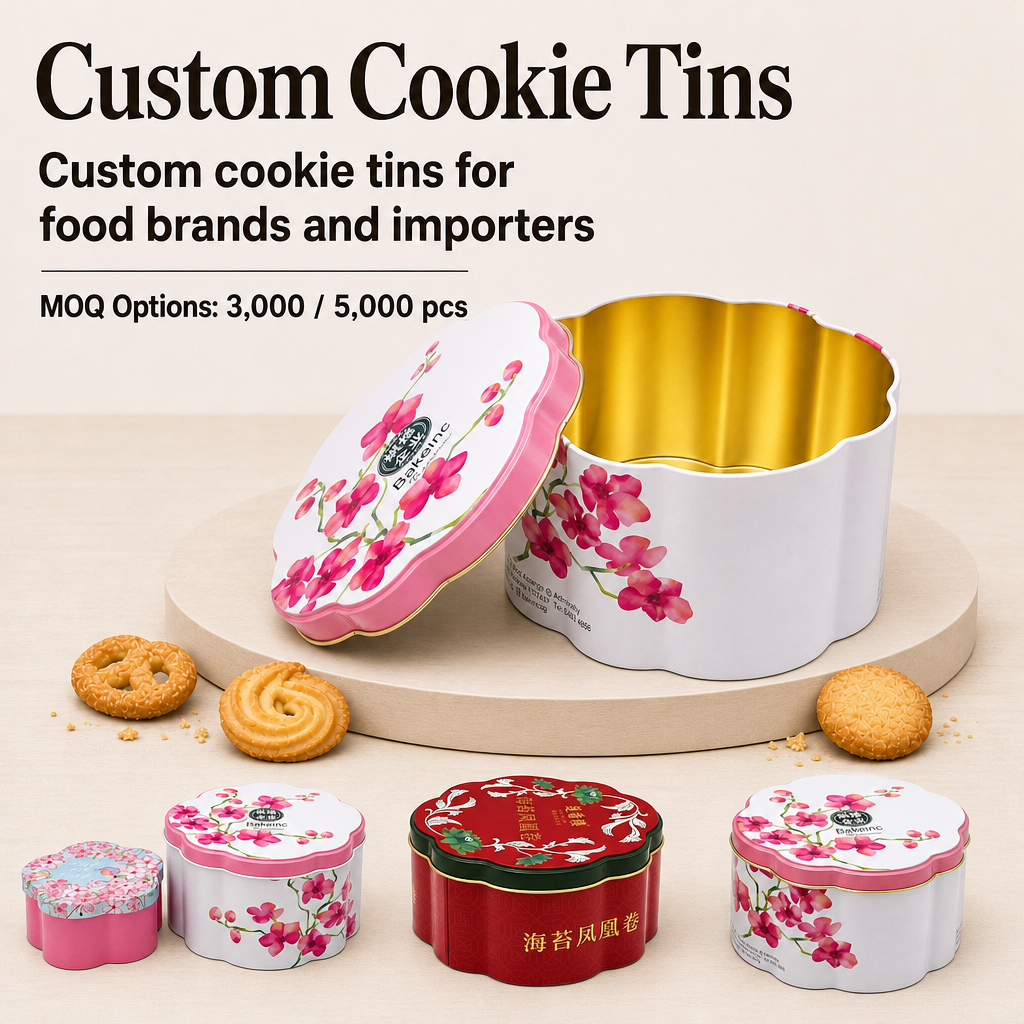
The Ultimate Cookie Tin Box Sourcing & Engineering Playbook: Specifications, Tooling, Food Safety, and Unit Economics
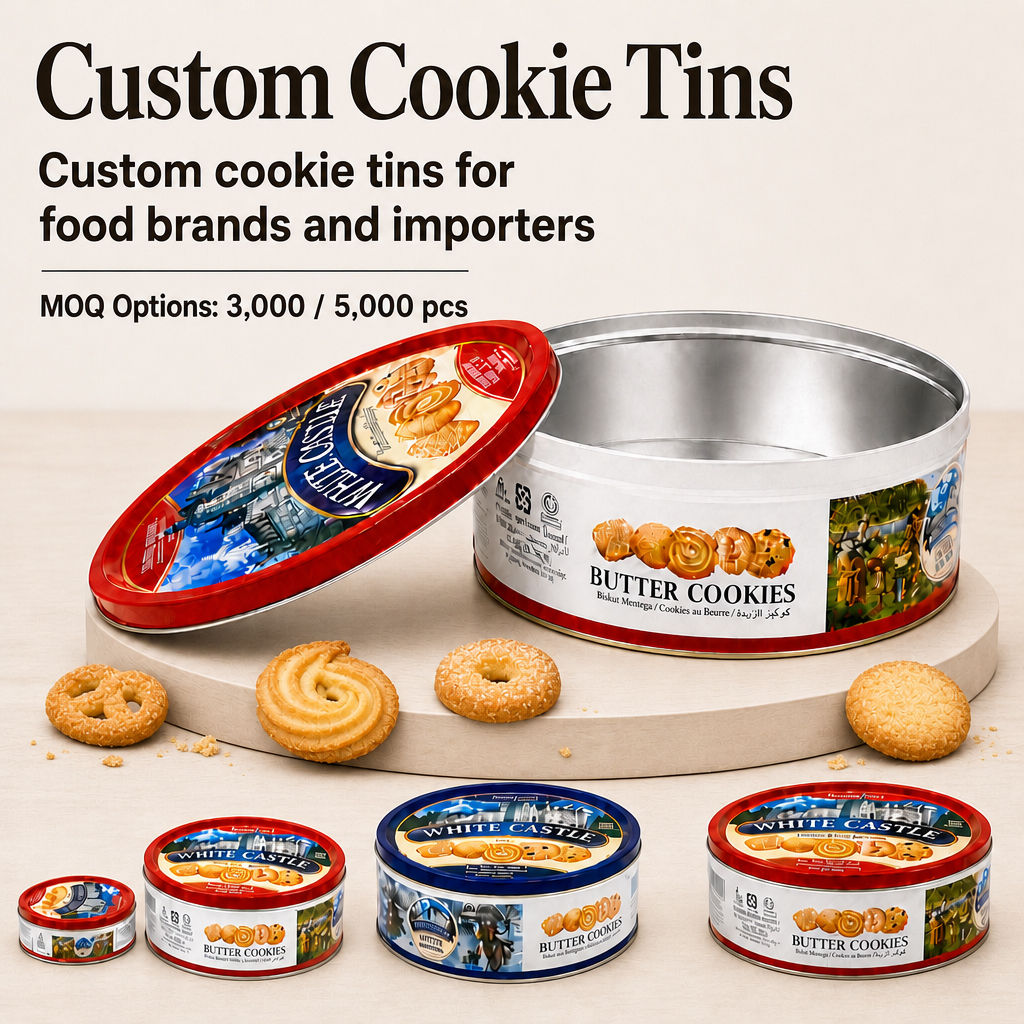
Direct Answer: How to Source the Right Cookie Tin Box
When sourcing metal packaging for butter cookies, shortbread, or festive biscuits, successful procurement balances four engineering fundamentals:
- Tinplate Gauge & Temper: Standard retail cookie tins require prime electrolytic tinplate (ETP) between 0.23 mm0.23 mm and 0.28 mm0.28 mm thickness with a Temper rating of TH52 (T3) or TH55 (T4). Using metal under 0.22 mm0.22 mm for large circular tins (>∅190 mm>∅190 mm) causes lid bowing, step-edge denting, and sea-freight collapse.
- High-Fat Food Safety (Butter Barrier): Because premium cookies typically contain 18%−35%18%−35% butter/fat, the interior must feature certified BPA-NI (BPA Non-Intent) gold lacquer or clear food-grade organosol compliant with U.S. FDA 21 CFR 175.300 and Regulation (EU) 2024/3190. Bare tinplate in direct contact with warm butter risks fat rancidity and sulfur-staining.
- Tooling Economics: Always evaluate a factory's existing mold library before investing in custom tooling. Standard Danish round tins (∅190×65 mm∅190×65 mm, ∅198×70 mm∅198×70 mm) and British rectangular shortbread tins (220×160×65 mm220×160×65 mm) carry $0 mold charges, saving $2,500–$5,000 in upfront tooling and cutting lead times by 3 weeks.
- Transit Anti-Crush Engineering: Cookie breakage during retail distribution is avoided through internal stack architecture: fluted greaseproof glassine cushions, customized food-grade PET/RPET blister trays, and outer master cartons tested to ISTA 3A drop standards.
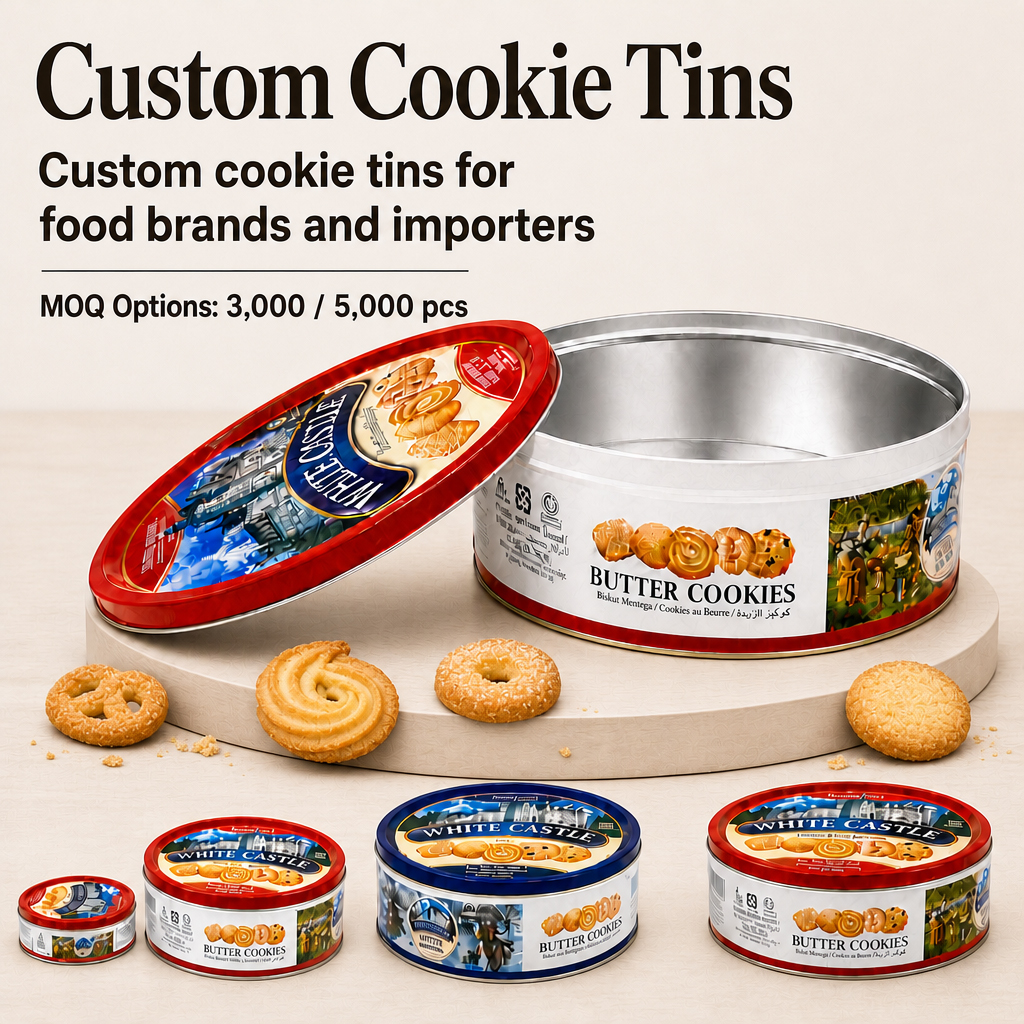
| Procurement Consideration | Commodity Retail Tins (Promotional) | Premium Bakery / Gifting Grade | Luxury Holiday / Collector's Edition |
|---|---|---|---|
| Typical Tinplate Thickness | 0.21−0.23 mm0.21−0.23 mm | 0.23−0.25 mm0.23−0.25 mm | 0.28−0.30 mm0.28−0.30 mm |
| Lid Construction | Step-down slip lid, outward curl | Step lid with snug friction fit, inward curl | Deep slip lid or heavy-duty wire-hinged cover |
| Interior Coating | Plain tinplate (requires parchment cup) | Food-grade clear/gold BPA-NI lacquer | Heavy-barrier Gold Organosol or PET lamination |
| Exterior Finish | Standard 4-Color (CMYK) Gloss | CMYK + Spot Pantone + Spot Matte/Gloss | CMYK + Multi-level 3D embossing + Metallic underlay |
| Internal Anti-Crush Pack | Wax paper wrapper | Corrugated glassine cup + divider | Custom thermoformed PET tray + top bubble pad |
| Target Unit Cost (FOB 10k pcs) | $0.65 – $0.95 | $1.05 – $1.65 | $1.80 – $3.20 |
1. Anatomy of an Industrial Cookie Tin: Beyond the Surface
A high-performance biscuit tin is not merely a stamped piece of sheet metal. It is an integrated protective enclosure composed of multiple engineered components:
The Inward vs. Outward Curl Safety Factor
When buying tins, examine the rim edge of both the lid and body:
- Outward Curl (External Rolled Edge): The raw slit edge of the tinplate curls toward the outside. While economical to manufacture, raw steel can be exposed to high-humidity air if the cut is not completely sealed with clear varnish.
- Inward Curl (Internal Sanitary Curl): The raw edge curls inward into the interior wall or under the lid flange. This leaves a 100% smooth, rounded exterior surface that cannot scratch consumer fingers and tucks the cut edge safely away from ambient moisture. At Fancy Tin, all food-grade gift tins utilize inward curl tooling as standard practice.
2. Choosing the Right Shape and Structure for Your Brand
Tin geometry dictates retail shelf presence, stacking stability, and freight utilization:
                          [Cookie Tin Structural Geometry]
                                         │
        ┌────────────────────────────────┼────────────────────────────────┐
        ▼                                ▼                                ▼
[The Classic Round]             [The Rectangular / Square]       [Novelty & Shaped]
 • Danish Butter Standard        • Shortbread & Assortments       • Holiday Christmas Tree,
 • High Radial Crush Strength    • 100% Pallet Space Efficiency   • Hearts, Houses, Books
 • Ideal for Rotating Trays      • Easy Hinged-Lid Integration    • High Collectibility Factor
1. The Classic Round Danish Tin
- Why It's Timeless: Circular geometry distributes external radial compression evenly. It has the highest top-load compression strength of any metal container format, making it exceptionally safe for 8-high pallet stacking.
- Best Suited For: Traditional butter cookies arranged in fluted paper cups around a central compartment.
- Standard Industry Sizes:
- ∅150×55 mm∅150×55 mm: 200g−250g200g−250g boutique/travel retail size.
- ∅190×65 mm∅190×65 mm: 340g−400g340g−400g standard retail benchmark.
- ∅198×70 mm∅198×70 mm: 454g454g (1 lb1 lb) classic holiday tin.
2. Rectangular and Square Shortbread Tins
- Why It's Practical: Zero wasted space on retail shelves and shipping cartons. Rectangular cartons achieve near 100%100% volumetric pallet cube utilization, reducing international sea-freight costs by up to 22%22% compared to cylindrical cans.
- Hinged Lid Option: Easily fitted with wire-formed or punched mechanical hinges. The lid remains permanently attached, turning the empty tin into a permanent sewing, stationery, or keepsake box.
- Standard Industry Sizes:
- 140×100×45 mm140×100×45 mm: 150g150g artisan mini-tin.
- 220×160×65 mm220×160×65 mm: 400g−500g400g−500g assortment gift box.
3. Specialty & Holiday Shaped Tins (Heart, Star, House, Book)
- Why Brands Love Them: Generates massive impulse-buy conversion during Q4 holiday seasons (Christmas, Valentine's Day, Lunar New Year).
- Tooling Caveat: Irregular shapes require specialized draw dies and manual or semi-automated seaming. Ensure your projected seasonal sales exceed 5,000–10,000 units to amortize custom tooling.
3. Food Safety, Butter Resistance & Regulatory Compliance
Cookie packaging is subject to stringent migration testing because butter, shortening, and vegetable oils are aggressive natural solvents that extract low-molecular substances from sub-standard coatings.
[Raw Butter / Fat Contact]
           │
           ▼
[Chemical Extraction Threat]
 ├─ Solubilizes Sub-Par Epoxies (Bad)
 ├─ Causes Microscopic Rust Stains (Bad)
 └─ Triggers Fat Rancidity from Metal Ions (Bad)
           │
           ▼
[The Engineered Defense]
 ├─ Certified BPA-NI Gold Organosol Coating
 ├─ 210°C High-Bake Oven Cross-Linking
 └─ Multi-Layer Glassine Fluted Paper Liners
Key Compliance Benchmarks to Demand from Your Supplier:
- Regulation (EU) 2024/3190 (The Bisphenol Ban): The European Union has enacted a comprehensive ban on Bisphenol A (BPA) and other bisphenols in food contact varnishes and coatings, with formal transitional enforcement beginning in late 2024 and 2025. Always require your supplier's coating Declaration of Compliance (DoC) to explicitly state "BPA-NI" (BPA Non-Intent formulation).
- Fatty Food Simulant Migration (Simulant D2): Because baked cookies contain high butter ratios, generic aqueous testing (3% Acetic Acid / Simulant B) is invalid. Tins must pass Overall Migration (OML) and Specific Migration (SML) testing using Vegetable Oil or 95% Ethanol (Simulant D2) under EU Regulation (EU) No 10/2011 and FDA 21 CFR 175.300.
- PFAS-Free Greaseproof Paper Cups: Under the new EU Packaging and Packaging Waste Regulation (PPWR 2025/40), per- and polyfluoroalkyl substances (PFAS) commonly used to make paper greaseproof are banned above 25 ppb. If you order corrugated paper cups or pads inside the tin, demand certified PFAS-free parchment certificates.
At Fancy Tin, all food-contact cookie packaging lines utilize premium PPG / Valspar BPA-NI internal gold or clear lacquers cured at precise temperatures exceeding 210∘C210∘C, ensuring zero volatile odor and certified zero-migration.
4. Decorative Finishes: How to Create a High-End Gifting Asset
Custom tinplate printing offers tactile, light-reflective branding possibilities that cardboard packaging cannot replicate:
                        [Advanced Metal Decoration Options]
                                         │
        ┌────────────────────────────────┼────────────────────────────────┐
        ▼                                ▼                                ▼
  [Print Technologies]             [Tactile Textures]             [3D Relief Tooling]
   • High-Definition Offset CMYK    • Spot Gloss vs. Deep Matte    • Single-Level Emboss
   • Spot Pantone Matching          • Crackle & Wrinkle Finish     • Multi-Level 3D Sculpted
   • Transparent Metal Underlay     • Soft-Touch Rubberized Coat   • Debossed Recessed Framing
- Transparent Metallic Inks: By applying colored translucent inks directly onto the reflective silver tinplate (without laying down a white base coat first), logos and graphics shimmer with genuine brushed-metal brilliance under store spotlights.
- Spot Matte & Gloss Contrast: Applying high-gloss varnish over your cookie imagery while coating the surrounding tin in velvety deep matte creates dramatic visual depth and luxury tactile appeal.
- Multi-Level 3D Embossing: Elevate your brand typography and holiday wreath graphics using CNC-machined micro-sculpted embossing dies. Consumers instinctively run their fingers across raised metal details, establishing an immediate subconscious perception of artisanal craftsmanship.
5. Tooling Economics & Sourcing: Existing Mold vs. Custom Mold
One of the largest budget traps for emerging food brands is paying unnecessary tooling fees for standardized container dimensions.
| Procurement Strategy | Existing Factory Mold (0 Tooling) | Custom Tooling (New Die Development) |
|---|---|---|
| Upfront Tooling Cost | $0 (Free Mold Use) | $2,500 – $6,000 USD (Shape & Draw Dependent) |
| Tooling Development Lead Time | 0 Days (Ready to Print) | 20 – 30 Days (Machining, Polishing, Test Punch) |
| Pre-Production Sampling Time | 7 – 10 Days (Color proof on stock can) | 12 – 15 Days after die completion |
| Minimum Order Quantity (MOQ) | 3,000 – 5,000 units | 5,000 – 10,000 units |
| Recommended Use Case | Standard round, square, or rectangular gift tins (90%90% of commercial requirements) | Patented brand-specific proprietary shapes, irregular novelty packaging, exact co-packer line fits |
Pro Buyer Tip from Fancy Tin: Before authorizing $3,500 for a new mold to achieve a dimension of 192×62 mm192×62 mm, ask our engineering team to cross-reference our 1,000+ existing mold library. We likely have a verified mold at ∅190×65 mm∅190×65 mm or ∅198×60 mm∅198×60 mm. Minor adjustments to height (cutting height) can usually be made on existing deep-drawn tooling with zero new mold charges!
6. Pre-Order Specification Checklist (Copy & Paste for RFQs)
Send this exact engineering specification sheet to your tin box manufacturer to eliminate quoting delays and prevent costly misunderstandings:
Frequently Asked Questions (FAQ)
How do I prevent cookies from breaking during shipping in a metal tin?
Metal tins protect against external crushing, but cookies can still fracture if they rattle against each other inside. Prevention requires a 3-part shock-absorption system:
- Nest cookie stacks snugly in custom thermoformed PET cavity trays or pleated glassine paper cups.
- Place a 3-ply or 5-ply food-grade corrugated glassine cushion pad directly on top of the cookies before closing the lid to take up vertical slack.
- Size the tin's internal height so the lid gently compresses the cushion pad when fully seated.
Can butter cookies be packed directly into a plain tin without paper cups?
If the tin interior is coated with a certified BPA-NI gold or clear organosol food-grade lacquer, direct contact is legally compliant. However, commercial bakeries still strongly recommend fluted glassine paper cups or greaseproof wax sheets. Direct contact without paper can result in butter staining the interior corners and makes it difficult for consumers to lift out delicate shortbread without crumbling.
What is the typical shelf life of cookies in a sealed tin?
Unopened cookies packed in a quality metal tin with an airtight shrink-band or heat-seal tape along the lid seam typically achieve a commercial shelf life of 9 to 18 months. The 100% light-blocking metal and zero moisture vapor transmission preserve crispness and halt lipid oxidation. Once opened, cookies stay fresh for 3 to 4 weeks if the lid is re-closed snugly in ambient conditions.
What is the standard production lead time for custom cookie tins?
- Tooling Phase (if new custom mold needed): 20–25 days.
- Metal Sheet Printing & Proofing: 10–12 days.
- Mass Stamping, Assembly & Packing: 25–35 days after artwork/sample approval.
- Recommendation: Because holiday cookie sales peak from October through December, brand owners should finalize tin orders and artwork by May or June to allow for ocean transit and retail distribution filling.
Source Certified Cookie Tins with Fancy Tin
Elevate your bakery brand with export-grade metal packaging built to withstand global freight and captivate retail consumers:
- 1,000+ Ready-To-Run Food Molds: Danish round tins, English shortbread boxes, and festive holiday shapes with $0 mold investment.
- Certified Global Food Compliance: 100% BPA-NI internal lacquers compliant with FDA 21 CFR, EU 2024/3190, and German LFGB standards.
- Full-Spectrum In-House Decoration: High-precision Fuji offset metal lithography, micro-registered 3D sculptured embossing, and spot matte/gloss varnishes.
- Turnkey Packaging Accessories: We supply matching corrugated cushion pads, food-grade PET divider trays, and tamper-evident shrink bands.
Contact Fancy Tin’s Packaging Engineering Team for a Custom Quote & Mold Catalog →
Danish Butter Cookie Tin Sourcing: Structure, Tray Layout, and Sizing Rules
What Size Tin Do You Need for Mints? Sizing Guide | Fancy Tin
Related Article