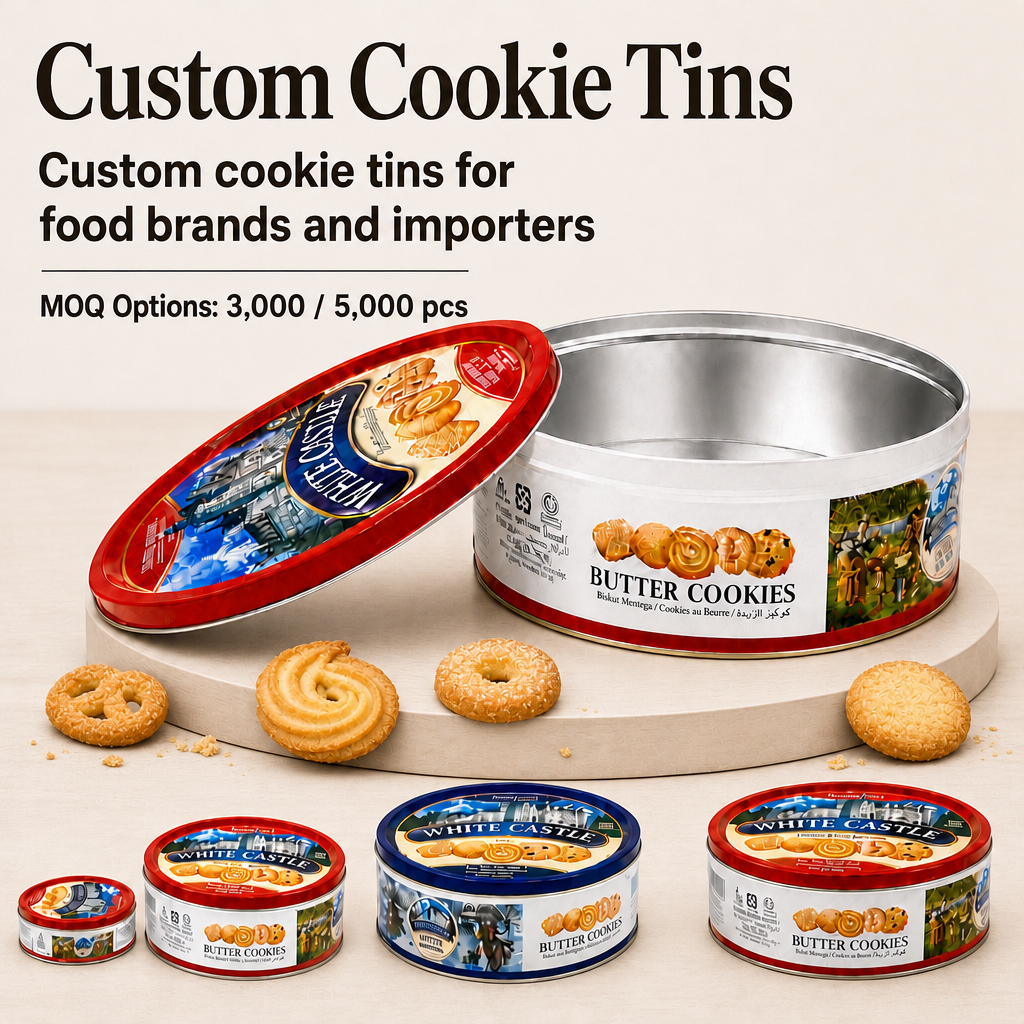
Danish Butter Cookie Tin Sourcing: Structure, Tray Layout, and Sizing Rules
Direct Answer: How to Size a Danish Butter Cookie Tin
Never select a tin by net weight alone (e.g., "I need a standard 454g round tin"). A Danish butter cookie assortment typically contains five distinct shapes—vanilla rings, rectangular fingers, round sugar-topped biscuits, butter swirls, and pretzel knots—each with unique baked tolerances, center-of-gravity fragility, and packing volume.
The golden rule of butter cookie packaging: Sizing is derived from the baked assortment layout outward, never from an external tin catalog dimension inward.
- Production Variation Tolerance: Measure actual commercial production samples across baking shifts, not hand-picked R&D lab samples. Width and thickness typically fluctuate by ±2 mm±2 mm to ±3 mm±3 mm.
- Open-Cup Flare Deduction: Fluted paper cups expand outward by 6−10 mm6−10 mm when cookies are loaded. Ordering a tin based on the cup’s flat bottom diameter causes edge crushing.
- Headspace Clearance: Allow 4−6 mm4−6 mm of vertical compression clearance so the corrugated top pad cushions the cookies without pressing down on fragile shapes like pretzels or rings.
1. Tin Shapes Compared: Round vs. Square vs. Rectangular
While the shallow round canister is the global hallmark of Danish butter cookies, alternative shapes offer specific operational advantages:
| Tin Format | Best Application | Key Structural Advantage | Logistics & Production Caveat |
|---|---|---|---|
| Shallow Round | Traditional mixed assortments (340g/454g340g/454g) | Instant category recognition; balanced radial crush strength | Leaves void space in rectangular shipping cartons (~18%−24%18%−24% pallet void) |
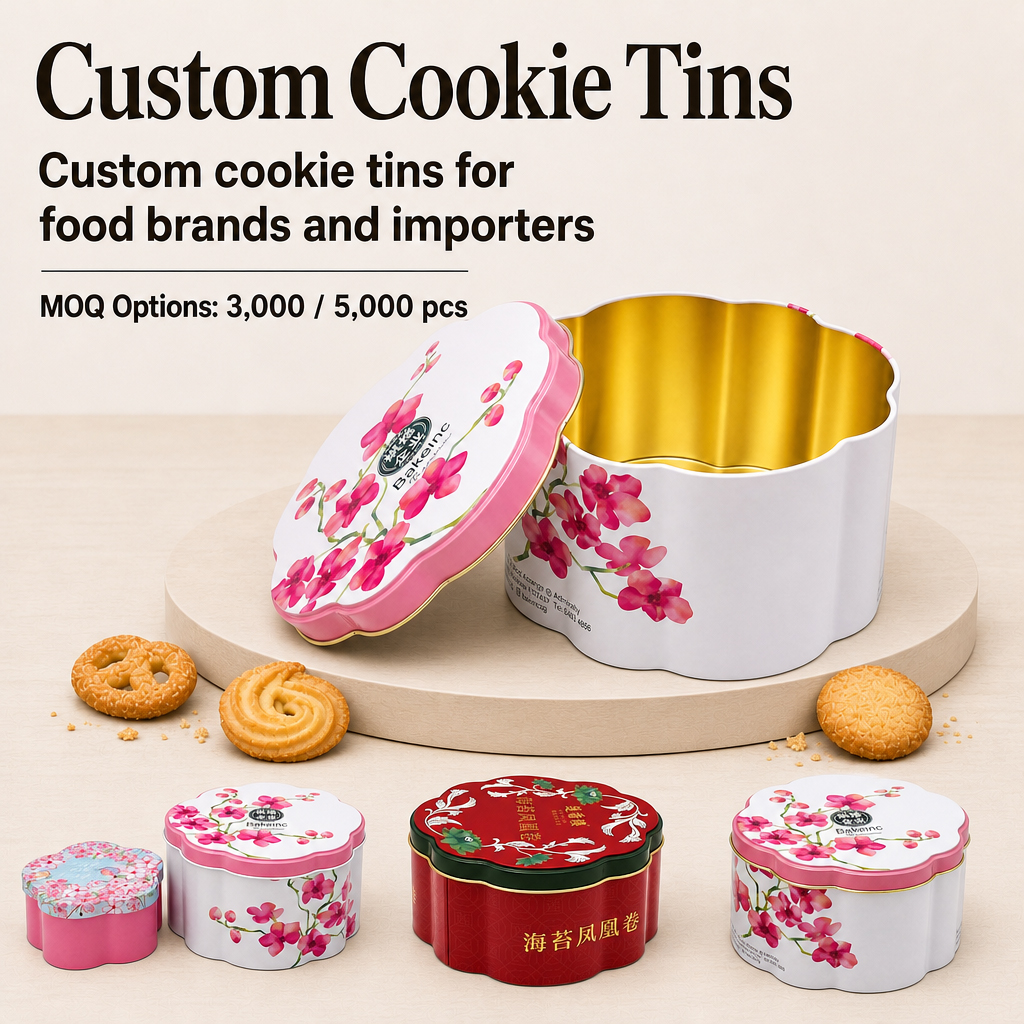
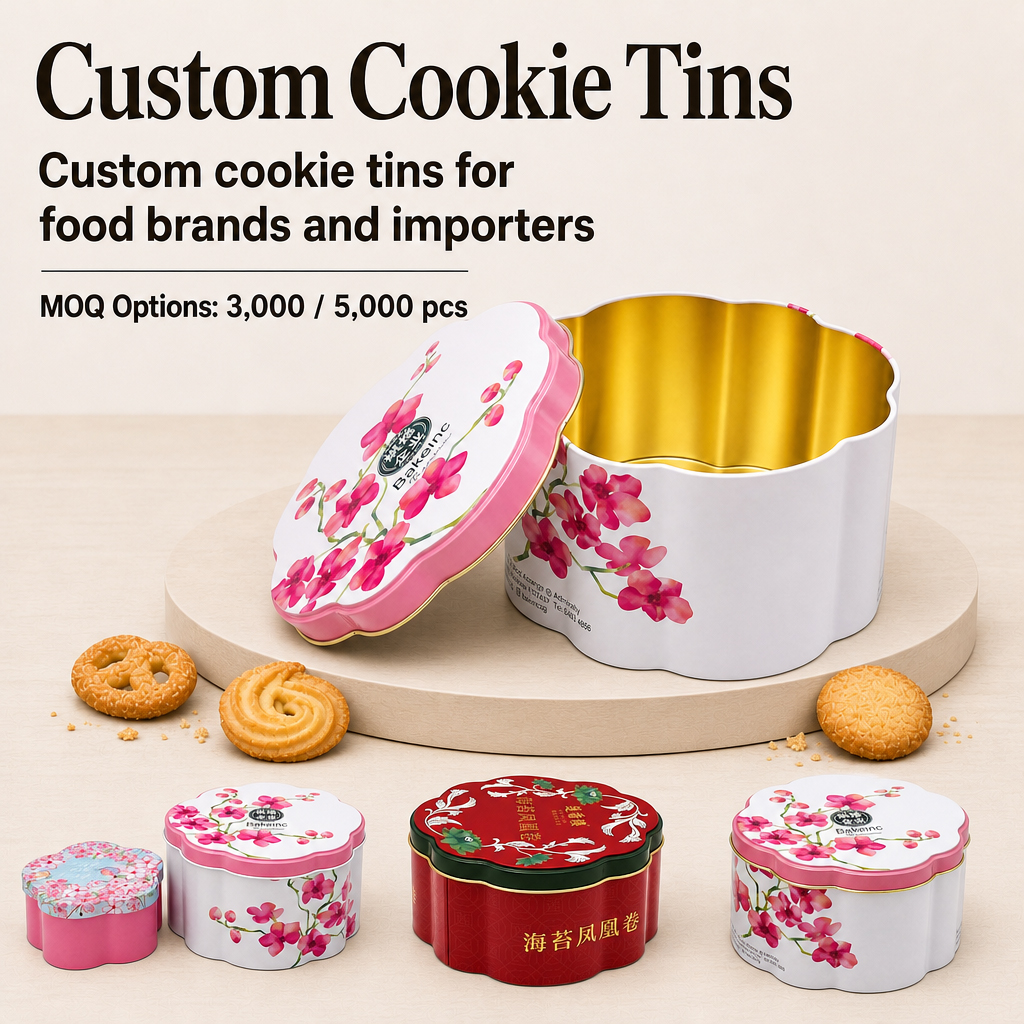
| Square | Modern gifting & single-variety butter biscuits | Clean grid presentation; uninterrupted flat artwork panels | Corner radius must be evaluated to prevent corner cookie pinching |
| Rectangular | Finger shortbread & tiered flavor bars | Highest pallet cube efficiency (near 100%100%); easy hinged lid pairing | Unused void space when packing round or circular cookies |
Logistics Reality: A round tin leaves circular gaps in master cartons, but its radial structure provides superior top-load compression during 8-tier pallet stacking. At Fancy Tin, we run container cube utilization modeling before freezing carton dimensions, balancing sea-freight density against carton crush resistance.
2. Internal Inserts: Paper Cups vs. Formed PET Trays vs. Hybrid
Cookie presentation upon opening defines the perceived value of the gift. Three insert systems dominate commercial production:
[Insert Architecture]
       │
       ├─► Paper Cups: Traditional, warm, high crumb control; requires manual loading.
       ├─► Formed PET Trays: Automated loading, rigid position; can look industrial.
       └─► Hybrid System: Paper cups nested in clear PET cavity trays; maximum stability.
| Factor | Fluted Glassine Paper Cups | Thermoformed Food-Grade PET Tray | Hybrid: Paper Cups in Clear Tray Base |
|---|---|---|---|
| Visual Impression | Classic, generous European bakery aesthetic | Clean, precise, and contemporary | Artisanal charm with engineered stability |
| Automated Packing Fit | Moderate (cups must be de-nested and opened) | High (ideal for high-speed pick-and-place lines) | High (trays with pre-fitted cups) |
| Vibration & Crumb Control | Localized to each cup pocket | High (individual contoured wells) | Maximum (cushion + structural pocket) |
| Moisture/Grease Barrier | Greaseproof (requires outer sealed bag) | Non-absorbent barrier layer | Greaseproof & non-absorbent |
| Tooling Investment | $0 (Standard off-the-shelf cups) | $800 – $1,500 thermoform mold | $800 – $1,500 thermoform mold |
3. Single-Layer vs. Multi-Layer Engineering
| Layer Count | Target Net Weight | Key Engineering Checks |
|---|---|---|
| Single Layer | 150g−300g150g−300g | Wide shallow footprint (∅190 mm+∅190 mm+); immediate visual reveal; zero bottom-tier pressure. |
| Double Layer | 340g−500g340g−500g | Requires a 3-ply corrugated glassine divider pad between tiers to equalize weight distribution and prevent sugar crystals from abrading lower cookies. |
| Three Tier | 908g908g (2 lb2 lb) Club / Foodservice | Requires deep draw or welded can body (H>100 mmH>100 mm); bottom tier must consist of dense round cookies, reserving fragile pretzel swirls for the top tier. |
4. Barrier Protection: Metal Lid vs. Sealed Inner Bag
A common misconception among first-time buyers is assuming a metal tin lid provides a hermetic seal on its own.
- The Lid is Mechanical Armor: Standard slip lids protect against light (100%100% barrier), pest intrusion, and crushing. They do not provide an airtight seal against ambient moisture transmission.
- The Inner Bag is the Freshness Core: The primary moisture (WVTRWVTR) and oxygen (OTROTR) barrier must be provided by a heat-sealed multi-layer barrier bag (e.g., KPET/PE or Metallized OPP) nested inside the tin.
- Internal Bag Fold Factor: When filled and heat-sealed, the folded top flap of the inner pouch adds 3−5 mm3−5 mm of vertical thickness. If this headroom is not factored into the tin depth, closing the metal lid crushes the top cookie layer.
5. Branding: Stand Out Without Losing Category Recognition
Most holiday butter cookie tins blend together into an indistinguishable sea of royal blue, gothic scripts, and generic European castles. You can maintain category cues while creating proprietary brand equity:
- Differentiate the Color Palette: While deep blue is the category default, warm cream, forest green, deep burgundy, and matte midnight navy convey equal heritage while standing out on retail displays.
- Selective 3D Micro-Embossing: Keep the tin lid background matte, but emboss your central brand crest or holiday frame. The tactile contrast immediately signals superior quality.
- Regulatory Origin Care: Labels like "Danish Style", "Danish Recipe", and "Made in Denmark" have strict legal definitions in destination markets (EU, FDA, UK). Ensure your artwork claims reflect your actual manufacturing site.
- Evergreen Body + Seasonal Sleeve: Avoid printing holiday dates or Santa graphics directly onto the metal. Use an evergreen premium tin design wrapped in an easily removable seasonal paper sleeve. Unsold units after Christmas can be de-sleeved and sold year-round with zero inventory write-off.
6. Sourcing Specifications & Standard Mold Dimensions
Avoid paying $3,000–$5,000 for custom tooling. At Fancy Tin, we maintain over 1,000 verified existing food-grade molds covering standard commercial Danish cookie footprints:
| Net Weight Benchmark | Recommended Tin Format | Industry Mold Dimension | Existing Mold Fee |
|---|---|---|---|
| 200g Boutique Tin | Shallow Round Slip Lid | ∅150×55 mm∅150×55 mm | $0 (Verified Die) |
| 340g (12 oz) Retail Tin | Classic Round Step Lid | ∅190×60 mm∅190×60 mm | $0 (Verified Die) |
| 454g (1 lb) Traditional Tin | Danish Round Step Lid | ∅198×70 mm∅198×70 mm | $0 (Verified Die) |
| 500g Assortment Box | Rectangular Hinged Lid | 220×160×65 mm220×160×65 mm | $0 (Verified Die) |
Frequently Asked Questions (FAQ)
What is the standard diameter for a 454g (1 lb) Danish butter cookie tin?
The global industry benchmark for a 454g454g (1 lb1 lb) two-tier Danish butter cookie tin is ∅198 mm×70 mm∅198 mm×70 mm height (internal depth approx. 65−68 mm65−68 mm). This comfortably houses two stacked tiers of 4 fluted cups around a central compartment, complete with divider pads and a folded inner barrier bag.
Why do paper cups crush cookies when closing the tin lid?
Paper cups are manufactured nested in sleeves. When loaded with cookies, their fluted walls flare open, increasing their effective diameter by 15%−20%15%−20%. If the tin diameter was calculated from flat cup bases, the flared paper folds upward against the lid, trapping crumbs and exerting downward pressure on fragile cookies.
Is an inner bag required if the tin is shrink-banded?
Yes. An exterior shrink band around the lid seam protects against tampering and transit dust, but it does not achieve an airtight food-grade seal. Butter cookies contain 18%−30%18%−30% butter; without a high-barrier inner bag, atmospheric moisture penetrates the seam within weeks, turning crisp shortbread soggy.
What is the minimum order quantity (MOQ) for custom-printed Danish cookie tins?
Standard custom-litho printed tins using existing molds typically start at an MOQ of 3,000 to 5,000 units per design. Sampling takes 7–10 days on flat tinplate, with mass production taking 25–35 days.
Partner with Fancy Tin for Your Cookie Packaging
Don’t risk cookie breakage or production delays with generic packaging brokers. At Fancy Tin, we manufacture export-grade biscuit tins engineered to your specific cookie assortment:
- Zero-Tooling Expense: Access 1,000+ verified round, square, and rectangular cookie molds.
- Certified Food Contact Safety: Internal BPA-NI gold and clear organosol lacquers compliant with FDA 21 CFR 175.300 and Regulation (EU) 2024/3190.
- Physical Fit Trials: Send us your dummy baked samples, and our engineering team will build physical mockups to confirm cup flare, headspace compression, and drop performance before tooling sign-off.
Contact Fancy Tin’s Packaging Engineering Team for a Custom Quote & Mold Review →
The Ultimate Cookie Tin Box Sourcing & Engineering Playbook: Specifications, Tooling, Food Safety, and Unit Economics
Related Article